

Spheriq AI uses a number of the platform’s central orientation concepts for many queries. Fit, hope, badges and support logics help to structure large amounts of information in a meaningful way, communicate a fit more easily or justify it better.
The non-profit sector does not function like a traditional market. An organization is not simply “good” or “bad”. A project is not generally suitable, but rather suitable from the perspective of a specific funding organization with individual goals, funding topics, target groups or impact areas.
Why Spheriq needs its own orientation signals
Accordingly, Spheriq must offer more than just a keyword search. And even more so Spheriq AI. The AI must “understand” whether subject areas match, target groups fit or an area of impact is relevant. It must understand the degree to which a promotion logic is fulfilled or whether a profile contains sufficient confidence-building information.
In digital systems, algorithmic calculations then produce abstract numerical values whose significance only grows with a lot of explanation. To ensure that users can still grasp the most important signals at first glance, the platform has been working with a series of simple concepts for some time:
- Fit: How well does something fit together?
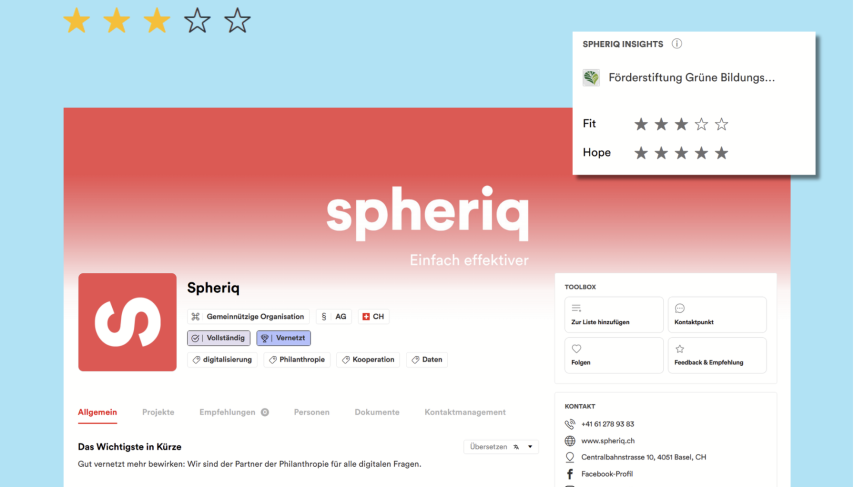
The fit describes how well an organization, project or application matches certain criteria. In the case of simple comparisons, it is primarily a question of subject areas, target groups and impact areas. For funding organizations with a detailed funding logic, it is also about specific funding criteria, mandatory requirements, exclusion criteria, form requirements and other conditions. A high fit means that there are strong overlaps; a low fit, on the other hand, means that there are no central matches or there are clear exclusions.
- Hope: Reliability and orientation
Hope describes reliability signals that help to better classify organizations and projects. On the one hand, it is about the quality of the available information and, on the other hand, about the experiences and feedback of other users. If, for example, the postal address in the commercial register is incorrect (although this would actually be legally mandatory), a low Hope value indicates that it is not worth the effort. Conversely, accessible documented funding relationships increase the Hope value, on both sides.
- Badges: Visible trust and profile features
Badges are visible signals on organizational profiles and show what profile quality has already been achieved. The “Complete” badge, for example, indicates that a profile has been fully completed and continuously maintained. The “Networked” badge, on the other hand, rewards an organization for the fact that its team members are active in various networks.
- Funding logic: The decisive difference
A funding logic is a structured presentation of the criteria of a funding organization. It describes which objectives, topics, target groups, impact areas, mandatory criteria, target criteria, exclusions, formal requirements, deadlines or typical funding conditions apply. And this is differentiated: The first funding priority may focus on different target groups than the second.
Fit, Hope, badges, profiles and promotion logic develop their strength through interaction. The concepts therefore work together systematically: the promotion logic influences the Fit, the badges influence the Hope. With the introduction of Spheriq AI, the concepts are now also directly integrated into the AI responses.
Matching with Spheriq AI
Spheriq AI can therefore display the fit as a star rating for a “Check matching” prompt, such as ★★★★☆ (4/5). However, it can also comment on the value. This is because in most cases, it is even more important for users to know why the value is lower or higher. It is also important to note that a high fit is not a funding commitment or a final recommendation. However, it does indicate the direction of an in-depth review.
The Fit is also used for funding research. Spheriq AI searches for suitable funding organizations based on your own profile or project. The search type, topics, target groups and geographical scope are clearly parameterized in the corresponding step of the pipeline (see Part 1 of the background series: Spheriq AI as a pipeline). The hits are sorted by fit.
If a detailed funding logic is available for a funding organization, the matching can be evaluated even more precisely. The AI then goes through each element of the funding logic individually, checks whether it is applicable and makes a corresponding assessment. In its response, Spheriq AI can then point precisely to those criteria that speak against a partnership.
AI-supported profile assessment and badges
Profiles are a fundamental concept on Spheriq. Once properly set up, they provide significant support for scouting or fundraising in the sector and also make it easier to submit applications later on. Spheriq AI helps organizations to gradually build up the necessary information. The “Assess profile” launcher quickly brings the crucial points to light.
The more complete and precise a profile is, the better Spheriq AI can categorize it. A good profile therefore not only explains what an organization does, but also guides Spheriq AI in finding suitable funding organizations or interesting projects. We therefore recommend starting with the profile for productive use of the AI.
Accordingly, strong profiles are rewarded with badges. It remains important: Badges are orientation signals, not a guarantee of quality, eligibility or a decision by a third party. Spheriq AI can evaluate badges that have already been received and show what is still missing for the next step.
Quick orientation thanks to AI and conveyor logic
Spheriq AI already has access to detailed funding logic for over a hundred funding organizations. This is a big difference to traditional funding searches. If you only search for keywords, you often find many seemingly suitable funding organizations. However, the decisive factor is whether a project meets all the specific criteria.
Unfortunately, philanthropy quickly becomes a jungle. Is funding only available in certain regions? Are individual events excluded? Is it worth applying for a printing cost subsidy for a publication or is this ruled out from the outset? Does the foundation require an implementation partner and what are the financial planning requirements?
Whereas in the past, it took a time-consuming search on the website or a call to the office to find out more, Spheriq AI can fully evaluate the funding logic in one go and compare it with a profile, project or application. This not only makes the assessment more precise, but above all much faster. Incidentally, the funding logic also supports Funders in scouting – according to exactly the same principle.
Limits of the orientation signals
Spheriq AI uses these concepts to provide guidance, not to make automated decisions. Fit and Hope are not guarantees. Badges are not conclusive judgments of quality. And funding logics do not anticipate funding decisions. Human review remains central everywhere. Spheriq AI can only explain why something seems suitable, where uncertainties lie and which next steps make sense.
However, the key concepts make AI in the non-profit sector much easier to grasp. They translate scattered and abstract information into clear guidance. It is precisely because these signals are not understood as absolute guarantees that their real value arises: they guide users to ask more targeted questions, to check in the right place – and to make more informed decisions.