
A seamless application process is one of the biggest challenges for a platform that wants to support both sides equally. We restructured this process with the last update. In this article, we show you what has changed. And why many things feel unfamiliar at first, but will soon be much easier.
Until now, submitting an application in Spheriq meant switching back and forth between profiles and forms. It was not always easy to maintain an overview. That’s why we have rethought and restructured the application process in a lengthy process. In doing so, we created a clearer structure, a more fluid process and better use of the recorded data.
Why this change is not trivial
Unlike traditional application tools, Spheriq aims to represent two perspectives on an equal footing: that of the applicants and that of the funding organizations. What should be as quick as possible for one side must be clearly structured and easy to evaluate for the other. Sometimes there is a conflict between these two requirements. Too much freedom makes the evaluation difficult, too much structure makes the recording process slow.
With the revision, we are creating a significant improvement for both perspectives:
- Logical structure: Applications now consistently follow the areas of person, organization, project and application.
- Fluid process: Applicants go through the entire process step by step in a flow
- Better use of data: Information is automatically stored in the profile and can be reused for further searches.
What will change for applicants?
1. Better structure and user guidance
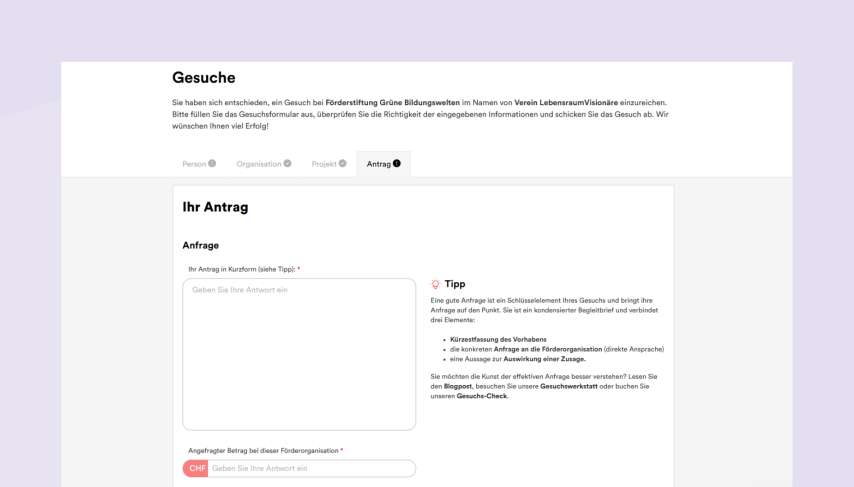
For applicants, completing an application will be much more structured and therefore more intuitive. Instead of a long form, applications are now divided into clear sections:
- Person
- Organization
- Project
- Request (e.g. enquiry and requested amount)
These areas appear as separate tabs while the form is being filled in – not just at the end when the information is checked. A status (✓ / ✕) for each tab also shows directly whether all mandatory fields have been completed or whether information is still missing. This allows applicants to maintain an overview at all times and know exactly where action is still required.
2. Fill in mandatory fields directly in the application
Previously, some key mandatory information had to be added directly to the organization and project profile; the actual application therefore needed to be left.
This information can now be entered directly in the application.
This makes the process much smoother, as applicants no longer have to switch back and forth between different areas of the application. This makes the entire process simpler.
3. Profiles and application grow together
When profiles are used, the details in the application and in the profile are newly linked. Changes in the application automatically update the corresponding profile, while existing profile data can continue to be used directly.
This results in less duplication of work and the data remains consistent – regardless of whether an application is started on the basis of an existing profile or directly in the form.
What will change for funding organizations?
The new logic also provides funding organizations with more structure and flexibility when setting up application forms in the Form Builder and a consistent presentation.
1. More flexibility through profile fields
When creating an application form, you now decide for each section whether the person, organization or project profile should be used.
If a profile is activated, you can select which profile fields are queried, arrange them freely and specify whether they are mandatory or optional fields.
This ensures that only the really relevant information is requested.
Some previous special options will become obsolete due to these possibilities – for example, in some cases you will no longer need separate forms for individuals or for applications without a project. These cases can now be mapped directly via the profile structure.
2. Place your own questions in the right context
Previously, individual questions always had to be asked collectively in the application tab – regardless of the content. This restriction has now been completely removed.
You can now also add your own questions in each of these sections. These appear exactly where they belong thematically and enable a logical and comprehensible structure of the application.
3. Consistent presentation and extended options
The structure of the form and the sequence of questions is also reflected in the application view. Foundation employees and the Board of Trustees also benefit from the logical structure. This facilitates orientation, improves comparability between applications and supports a more efficient evaluation.
In addition, new verification options are available: You can define whether an identity check for individuals or a verification of the organization (including tax exemption) should be requested for the application submission.
Conclusion: Strengthening the profile logic – with benefits for everyone
With the revision of the application process, the Spheriq approach is being consistently strengthened: structured, interlinked data as the basis for efficient funding processes.
For applicants, this means clearer guidance through the process, less switching between different areas and a noticeable reduction in data entry. At the same time, funding organizations benefit from a consistent structure, more comparable applications and more flexibility in the design of their forms.
The logic behind the approach remains familiar. The way you move through the process changes. The result: a consistent, transparent and significantly more efficient application process that brings both perspectives together. Simply more effective.