A foundation’s capital always plays a role—through the projects it funds and the way it is invested. A credible investment strategy therefore balances the foundation’s mission, returns, risk, and values.
Foundations are judged by the impact of their projects—but increasingly also by how they invest their assets. This raises the question of how consistently a foundation wishes to pursue its mission when managing its assets.
The issue goes far beyond the often-cited exclusion of tobacco companies from foundations dedicated to promoting health. It arises, for example, when foundations that promote climate protection invest in fossil fuels, or when they hold stakes in pharmaceutical companies despite their commitment to affordable access to medications.
Currently, there are also yield-optimized real estate investments made by socially oriented foundations. Such conflicting objectives demonstrate that a credible investment strategy cannot be achieved through exclusion lists alone. Foundations must clarify what they expect their assets to achieve and how their mission, returns, risk, and individual values interact.
When Purpose and Assets Work Together
Credibility arises when three elements align: purpose and values, investment strategy, and transparent communication. For foundations, this means that a foundation’s investment activities should secure its charitable purpose in the long term—and, at the very least, not contradict it. This is not about ideology, but rather about striking a professional balance between the long-term preservation of the foundation’s assets, returns, risk, and personal values.
Many organizations initially feel overwhelmed by discussions of sustainability in the context of investing. However, what’s needed isn’t a perfect sustainability strategy, but a clear first step.
Sara Huber Sigrist, Head of Foundations at Zürcher Kantonalbank
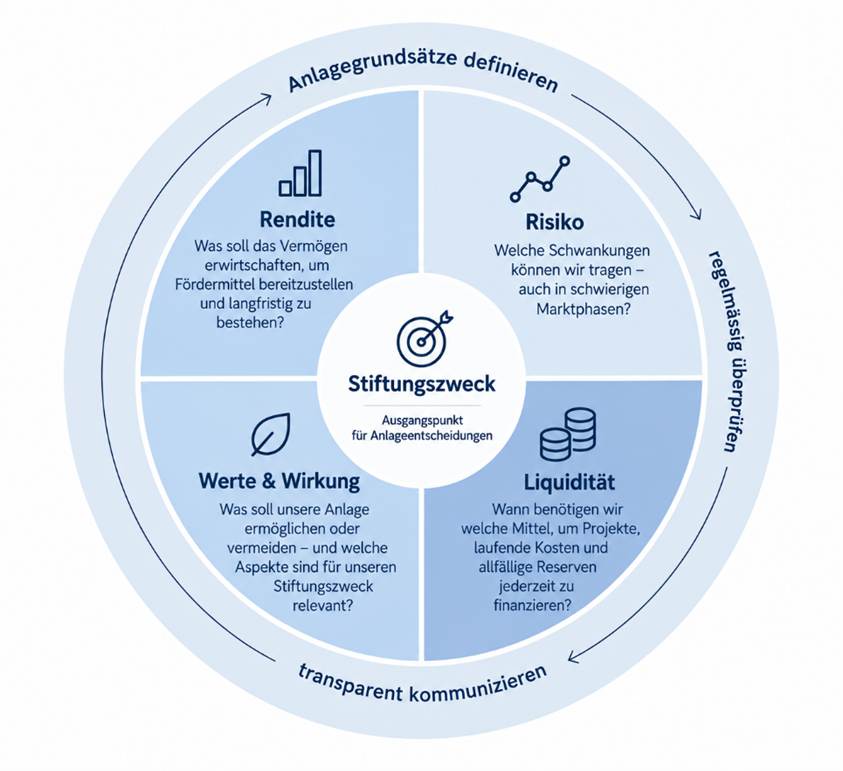
Three strategies have proven effective in practice:
1. Clear Investment Principles
Professional investment policies address three key questions:
What rate of return does the foundation aim for in order to secure its mission, annual grants, and the purchasing power of its assets over the long term?
What level of risk is acceptable in light of the foundation’s purpose, time horizon, obligations, and risk tolerance—even during difficult market conditions?
What level of liquidity is needed to finance approved projects, ongoing expenses, and any necessary reserves at all times?
Based on this, investment objectives, the risk/return profile, and the strategic asset allocation (e.g., stocks, bonds, real estate, cash) are determined.
2. Sustainability with a Sense of Proportion
Sustainability does not necessarily begin with a long list of exclusions. The key question, first and foremost, is which aspects are actually relevant to the foundation’s specific purpose. These may differ for a health foundation compared to an environmental or social foundation.
From this, specific investment principles can be derived; for example, exclusions of certain business sectors, minimum standards for funds, or targeted impact-oriented investments. This can give rise to conflicting objectives: A stronger focus on the foundation’s purpose may narrow the investment universe or have implications for costs, liquidity, and diversification. These consequences should be carefully weighed. Sustainability thus becomes not an end in itself, but an integral part of the investment strategy.
3. Transparency Instead of Perfection
Trust is built when foundations disclose the principles guiding their investment decisions—even if not everything is “green” yet. A minimum set of information in the annual report includes: a few sentences on the investment strategy (including the return/risk profile), how sustainability is addressed, and an honest outlook, such as: “In the coming year, we will review our investment criteria and define which sustainability requirements should apply to the entire portfolio going forward.”
What a banking partner should provide
The banking partner plays a key role in this process. What is needed is a partner who takes a holistic approach to foundations: one with an understanding of a foundation’s purposes and governance, proven expertise in return-and-risk issues and sustainability, and transparent reporting on costs, risks, and sustainability. A good banking partner works with the foundation to translate these requirements into a practical investment strategy, identifies conflicting objectives and their financial consequences, and, through transparent reporting, lays the groundwork for the board of trustees to make regular decisions.
An investment strategy is therefore more than just a financial decision. It demonstrates how a foundation aligns its charitable mission, its stewardship of assets, and its values. A foundation that integrates its mission, risk/return profile, and values into its investment strategy not only strengthens its impact and assets—but, above all, builds trust in the foundation and enhances its reputation: In this sense, the capital plays an active role—and sends a clear signal about what the foundation truly stands for in the long term.
Do you have questions about your foundation’s investment strategy? We’d be happy to advise you.
Sara Huber Sigrist heads the Foundations division at Zürcher Kantonalbank. She and her team support and assist nonprofit organizations as a reliable banking partner in all matters related to financial management. The team of experts develops comprehensive, tailored solutions that take into account the relevant strategic and governance aspects—with a focus on asset management, as well as financing and the full range of other banking services.
> Further information and contact details
Our Commitment to the Sector
Since 2018, we have been working alongside Spheriq, leading Swiss grant-making foundations, and other stakeholders to advance the Swiss philanthropy sector. Together, we are committed to building a digital infrastructure that connects the sector, fosters dialogue, and supports its continued development.
Legal Notice: This article is provided for informational and promotional purposes. It does not constitute an offer or a recommendation to purchase services, nor does it form the basis for a contract or any obligation of any kind. Zürcher Kantonalbank reserves the right to modify or discontinue services at any time without prior notice. The provision of services may be subject to restrictions due to legal, regulatory, or tax provisions. This article was prepared by Zürcher Kantonalbank with the due care customary in business. Nevertheless, the accuracy, completeness, and timeliness of the information cannot be guaranteed. All information is provided solely for general informational purposes and is not a substitute for personal advice. Zürcher Kantonalbank therefore makes no warranty and disclaims all liability for decisions based solely on this article. Copyright © 2026 Zürcher Kantonalbank