Grant-making foundations invest in projects designed to bring about social change. But what about the organizations that implement these projects? The practical guide “Funding Organizational Development: From Insight to Action” by the European foundation network Philea shows why long-term impact does not depend solely on successful projects. It also highlights the challenges that arise in this process.
A nonprofit organization wants to expand its services. Demand is rising, its projects are making a difference, and funding for new activities is on the horizon. At the same time, the team is reaching its limits. Internal processes are not geared toward further growth, leadership responsibilities are not clearly defined, and there is a lack of time and resources for strategic development.
What does this organization need?
Additional project funding, or an initial investment in its own structures? This hypothetical scenario illustrates a fundamental challenge in philanthropy. While funding often focuses on specific projects and their outcomes, the organizational conditions necessary for their implementation are easily overlooked. Yet the long-term impact of a project depends largely on how well-positioned the organization supporting it is.
Philea’s practical guide , “Funding Organizational Development: From Insight to Action,” addresses this question. It is aimed at funding organizations that not only support their partners in implementing individual projects but also wish to contribute specifically to their long-term development.
Organizational development is more than just professional development
Organizational development, known internationally as Organizational Development (OD), encompasses the systematic advancement of an organization. This includes its strategy, leadership, organizational culture, governance, and internal structures. Closely related to this is “capacity building,” which refers to the targeted development of capabilities and resources. While capacity building often addresses specific development needs, organizational development takes a more holistic view of the organization and considers the interplay among its various components.
This distinction is relevant to funding practices. After all, not every organization needs additional training or external consulting. Sometimes the challenge lies deeper—for example, in the leadership structure, a lack of human resources, or a strategy that no longer aligns with the organization’s development.
Organizational development is therefore not a one-time endeavor, but rather an ongoing process. It is intended to enable organizations to effectively fulfill their responsibilities over the long term, adapt to changing conditions, and shape their own future.
Six Key Areas Take Center Stage
The demands placed on nonprofit organizations are changing. Philea has identified six key areas that are becoming increasingly important in supporting organizational development: crisis management, financial resilience, mental health and well-being, safety, conflict sensitivity, and digital transformation.
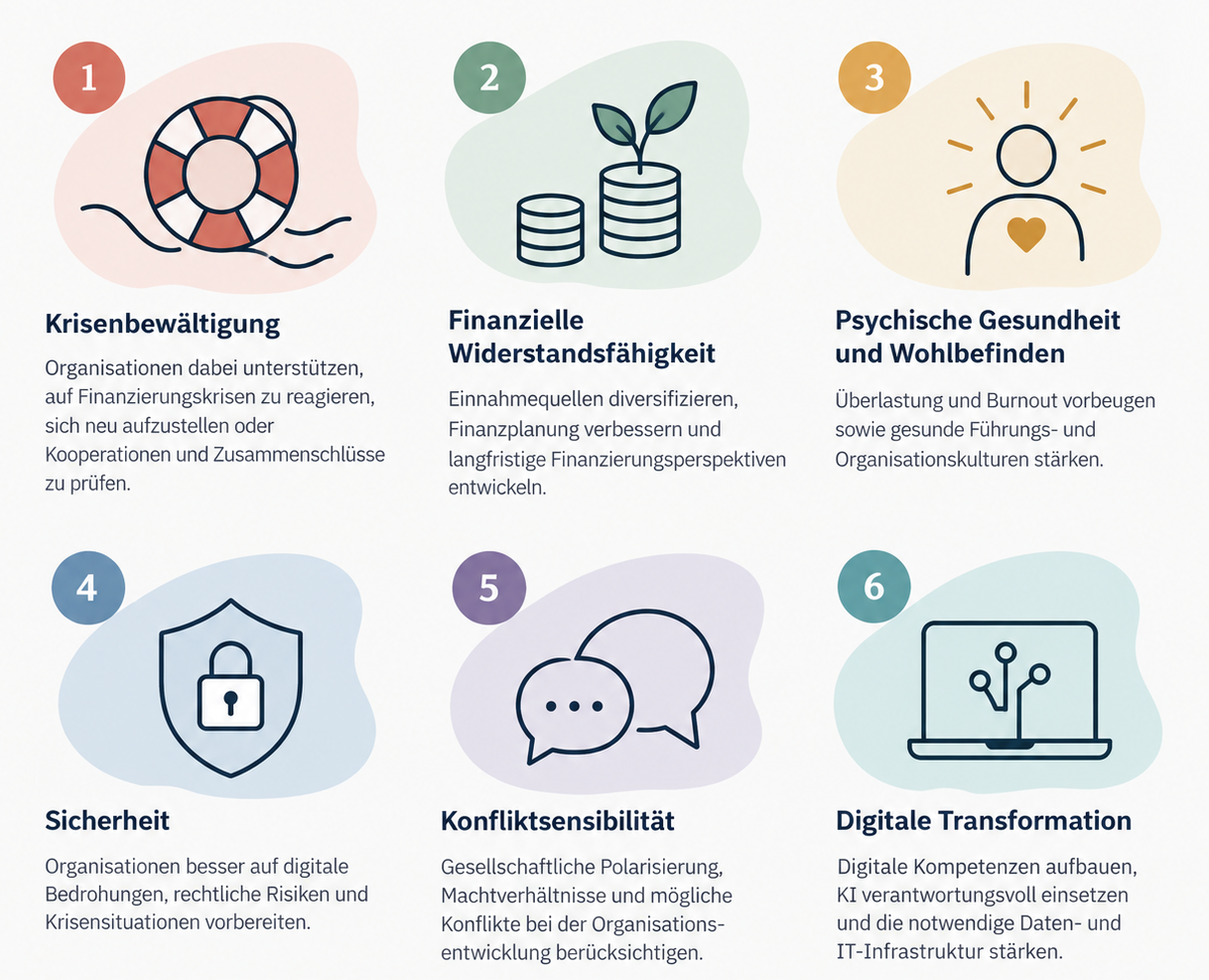
This also broadens the perspective on organizational development. In addition to effective structures, greater emphasis is being placed on the resilience, adaptability, and long-term capacity for action of nonprofit organizations.
Who decides what an organization needs?
A key insight from the guide concerns the relationship between funders and grantees. After all, those who finance organizational development can potentially influence how an organization operates. This can lead to conflicting goals. For example, a foundation may see a need for improvement in leadership or impact measurement. The funded organization, on the other hand, may view other challenges as more urgent.
In a situation like this, who decides what course of action makes sense?
Philea advocates an approach that respects organizations’ autonomy. Funders should facilitate development processes without dictating their outcomes. This involves trust, openness, and a willingness to allow for different perspectives.
Ten case studies in the guide illustrate just how challenging this can be in practice. One of them describes an organization that wants to slow down its planned growth in order to first strengthen its financial systems and internal processes. From a grant-making foundation’s perspective, this might appear to be a lack of momentum. In reality, however, the decision may reflect responsible organizational leadership.
Even well-intentioned questions from sponsors can be interpreted as hidden instructions. Financial dependence changes the dynamics of the conversation, even if no explicit guidelines are given. This makes it clear that organizational development is not just a matter of technical support; it also requires a conscious examination of the role and influence of funding organizations.
What does this mean for Swiss grant-making practices?
The Philea guidelines also provide food for thought for the Swiss foundation landscape. If grantmaking foundations wish to achieve long-term social impact, it is worthwhile to look beyond the quality of individual projects. Equally relevant is the question of whether the organizations receiving grants have what it takes to continue their work sustainably. This applies in particular to investments that cannot be directly attributed to a specific project: the further development of a strategy, the establishment of professional human resources management, the digitization of internal processes, or the strengthening of financial planning.
Such changes require time and resources. Their impact often cannot be demonstrated as immediately as the results of a single project. In addition, development needs can change. What appears urgent at the beginning of a funding relationship may not remain the right priority throughout its entire duration. This is where traditional funding strategies can reach their limits. The more strictly funds are earmarked and the shorter the funding periods are, the less leeway there may be for an organization’s further development.
This does not mean that project funding is fundamentally outdated. Rather, the question is which funding instrument is best suited to which need. Project grants, operational funding, and targeted support for organizational development serve different functions and can complement one another. This opens up an additional avenue for grant-making foundations to maximize their impact. They can not only enable socially relevant projects but also help ensure that the organizations behind them remain capable of acting in the long term.
This does not necessarily require new funding programs. Rather, it is worthwhile to review existing funding instruments and collaborations with partner organizations to determine whether they facilitate or inadvertently hinder their development.
The impact doesn’t begin with the project itself
The Philea Guide encourages us to broaden our perspective on successful funding. What matters is not only the results a project achieves, but also whether the organization behind it is capable of fulfilling its social mission in the long term. This requires sustainable structures, competent staff, and the ability to respond to change.