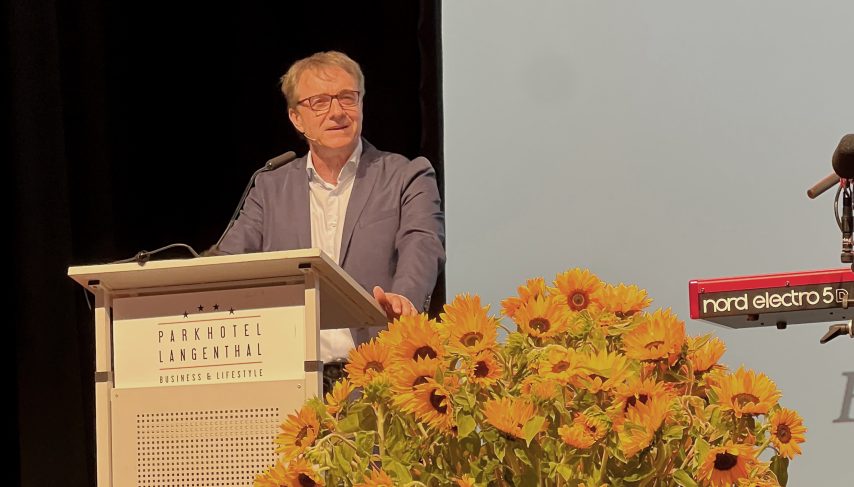

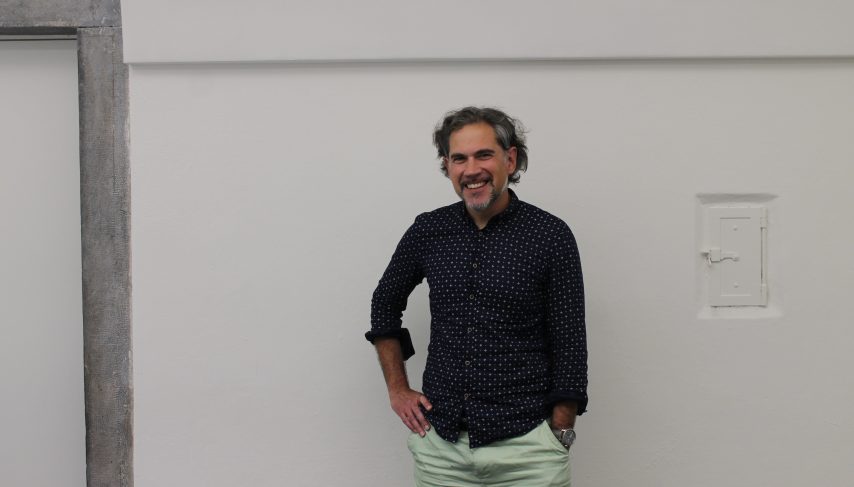
With the new translation tool ALAS, the umbrella organization Lia Rumantscha is laying the foundations for ensuring that Romansh remains present in the digital space. Ignacio Pérez Prat is responsible for the digital transformation and explains why foundations play a particularly central role in promoting linguistic infrastructure.
For over 100 years, Lia Rumantscha, the non-profit umbrella organization of Romansh language associations, has been committed to the preservation and promotion of Romansh in Switzerland. According to Ignacio Pérez Prat, little has changed in terms of the task of preserving the language itself, but the framework conditions have.
For a language to remain alive, it must be present where everyday life takes place. Today, this also means in the digital space. With the freely accessible translation tool ALAS, Lia Rumantscha is taking this step into the digital world with the same claim to linguistic sovereignty as it did 107 years ago.
Many minority languages are under pressure. What additional challenges does the digital transformation pose for Romansh today?
Ignacio Pérez Prat: As soon as private companies have to decide whether our language is integrated or not, it becomes difficult. Last year, we comprehensively revised the Unicode CLDR localization standard for Romansh. [Editor’s note: The Common Locale Data Repository (CLDR) is an international standard for the digital representation of languages.] To date, big tech companies have not adopted any of it. Inquiries to technology companies, including their Swiss representatives, remain unanswered.
What about the availability of data in Romansh?
This is an additional challenge. We are mostly talking about text here. Today’s technologies such as language models or neural networks, i.e. artificial intelligence (AI), need a lot of data. But quantity alone is not everything. You also need data in the right formats, and in some cases specific data sets that are specially produced in Romansh. We are tackling this challenge systematically and solving it step by step for all those who want to carry out projects with Romansh in the future.
With ALAS, you have created a freely accessible translation tool. Why was this step important right now?
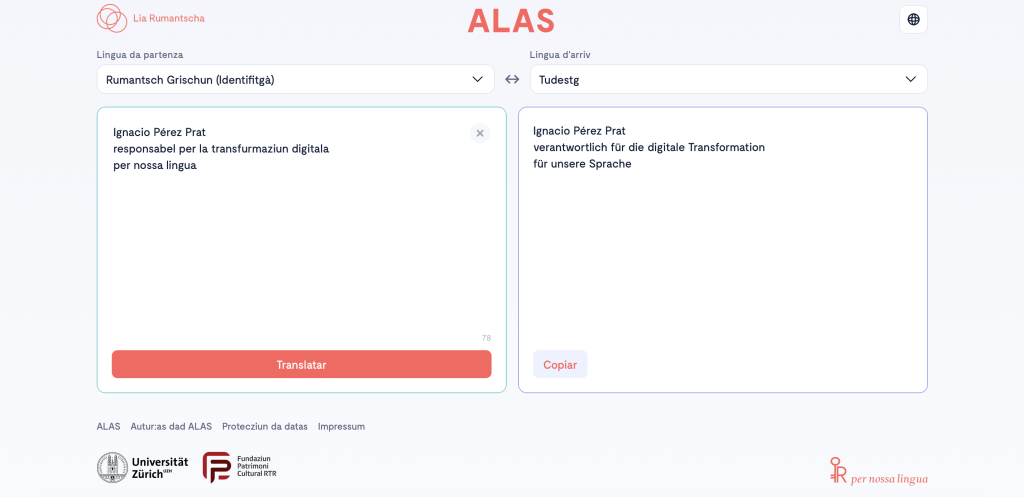
According to our needs assessment, which we conducted as part of our digitalization strategy, machine translation was the most frequently mentioned topic. For example, this was mentioned as a need by all 24 participating municipalities. Romansh-speaking institutions also requested such a solution.
How has the Romansh-speaking community reacted to ALAS so far?
The reactions so far have been very positive. On the one hand, the feedback was that this was a great need for many people, and on the other hand, people were very impressed by the quality. Of course, some people have encountered the typical weaknesses of an AI system. For example, individual words are not translated as well as whole texts, but we still have our online dictionaries. We see the biggest compliment in the fact that ALAS has been used on a daily basis since its launch.
We see the biggest compliment in the fact that ALAS has been used on a daily basis since its launch.
Ignacio Pérez Prat, responsible for digital transformation at Lia Rumantscha
What is the significance of a small language community being able to “keep up” technologically?
In our view, this is a strategically important task. However, we have to make sure that we always work within the framework of our core competencies and procure other competencies through partnerships. Our core competence is language and we are sticking to that. When it comes to technology, we look for the right partner institutions that have the best expertise for a given technology at that moment. In today’s world, applications are changing relatively quickly and new technologies are emerging rapidly. We have to work on the basis and ensure that we can develop new technologies with the same basic data.
Is digital visibility a prerequisite for linguistic survival today?
Yes, from a sociolinguistic point of view, it is very important for the identity of a language community to see that its own language is present and alive in the various areas of everyday life. The digital space is an important part of everyday life today.
As a digital translation tool, how does ALAS help more people to actively learn, speak and pass on Romansh? Can it do that at all?
ALAS is being added as a new service and is now part of an existing landscape of support and services that help people learn, speak and pass on the language. Other new services will also be added. A single project is not enough. Many synergies can be exploited from the project that led to ALAS. For example, an automatic recognition system for Romansh texts was developed for ALAS, which can differentiate very accurately between the Romansh writing standards. We can use this to classify more texts for new projects.
What role do foundations and other funding partners play in the development of such projects?
Foundations play a very important role in such projects. ALAS has a real effect on the everyday lives of many people. This is a great example of how a foundation can use funding to have a tangible impact on society.
[ALAS] is a great example of how a foundation can use funding to have a tangible impact on society.
Ignacio Pérez Prat, responsible for digital transformation at Lia Rumantscha
How did you manage to finance this project?
A large part of the financing was provided by the Fundaziun Patrimoni Cultural RTR and the rest by our own contribution.
How do foundations perceive Romansh speakers as a minority – does that make your work easier or more difficult?
In the context of Switzerland as a whole, Romansh speakers are in the minority – that’s true – but not in a Romansh-speaking community. So it’s also a question of perspective. From our point of view, there can certainly be no question of making things more difficult. The funding from Fundaziun Patrimoni Cultural RTR in this case shows that there is plenty of scope for foundations to get involved in promoting our language. But there is still a lot of potential for foundations in various areas. The impact is very often underestimated by reducing the importance of our language to the number of speakers. Multilingualism affects us all.
Where do you see the added value for funding foundations when they invest in cultural and linguistic infrastructure?
Foundations have a positive impact on society through their funding. Both culture and digitalization are flooded with private and commercially motivated offers that do not always focus on society, but rather on private interests. Foundations are well placed to counteract this.
How do you measure the impact of a project like ALAS? Or to put it another way: How do you recognize whether it is successful?
Everyone who has expressed the need for machine translation is very satisfied with ALAS and uses it on a daily basis. Added to this are the reactions from the general public, who also see the added value. The ALAS target group is growing every day. In the first two weeks since the launch of ALAS, around 40,000 translations have been made. This includes people who enter something out of curiosity as well as people who already use ALAS every day at work. That’s a big number for us. We want to increase the reach of ALAS in order to achieve greater visibility for our language.