
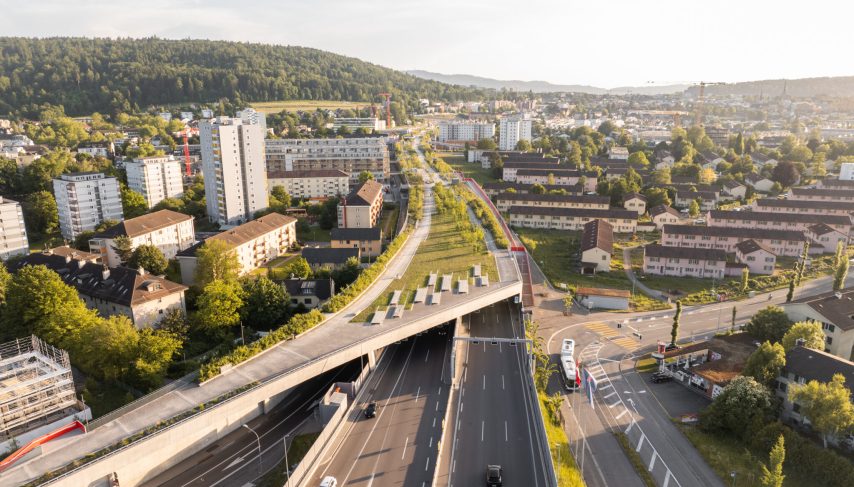
Ueberlandpark in Zurich’s Schwamendingen neighborhood will win the 2026 Binding Prize for Biodiversity. Here, infrastructure and nature enrich one another. A 950-meter-long park has been created on the roof of a highway underpass. While 120,000 vehicles pass by, the roof provides a habitat for hundreds of plant and animal species. As the Sophie and Karl Binding Foundation notes, this project “impressively combines biodiversity, design, and technical infrastructure.”
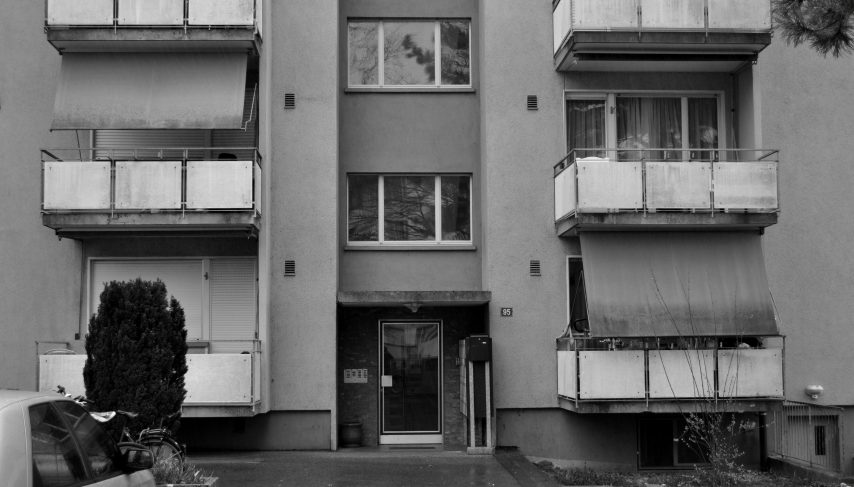
What began in the late 1990s as a citizens’ initiative against noise and air pollution is now a flagship project for promoting nature in urban areas. More than 120,000 vehicles travel through Zurich daily on the A1 highway. In March 2019, construction work on the noise barrier began under the leadership of the Federal Roads Office (ASTRA). The Ueberlandpark has been open for a year. Zurich voters approved the necessary funding in two referendums (2006 and 2015). Today, at a height of eight meters, the new open space stretches over a length of more than 950 meters and a width of 30 meters. Grün Stadt Zürich writes that the park “significantly shapes Schwamendingen.” It is described as a “large open-air laboratory for urban nature.” The road to this point was rocky. The original 2006 project called for only basic landscaping. The climate debate and the accompanying neighborhood petition, as well as society’s demand for high-quality public spaces, led to a fundamental redesign of the plan. In the 2021 municipal referendum, residents approved a supplementary budget to fund additional trees, playgrounds, fountains, and dining options.
Participatory Development
As the Sophie and Karl Binding Foundation emphasizes in its commendation, the Ueberlandpark is “a testing ground for climate-adapted greening of the cities of tomorrow.” As a result, 100 percent of the prize money—100,000 Swiss francs—will go toward the participatory further development of the Überlandpark. In this way, the foundation is recognizing not only a completed project but also the ongoing process of shaping the park and the community together. With this award, the foundation honors an approach that views infrastructure not as opposed to nature, but as an opportunity to connect habitats, strengthen biodiversity in urban areas, and enhance quality of life for people.
Biodiversity in Extreme Environments
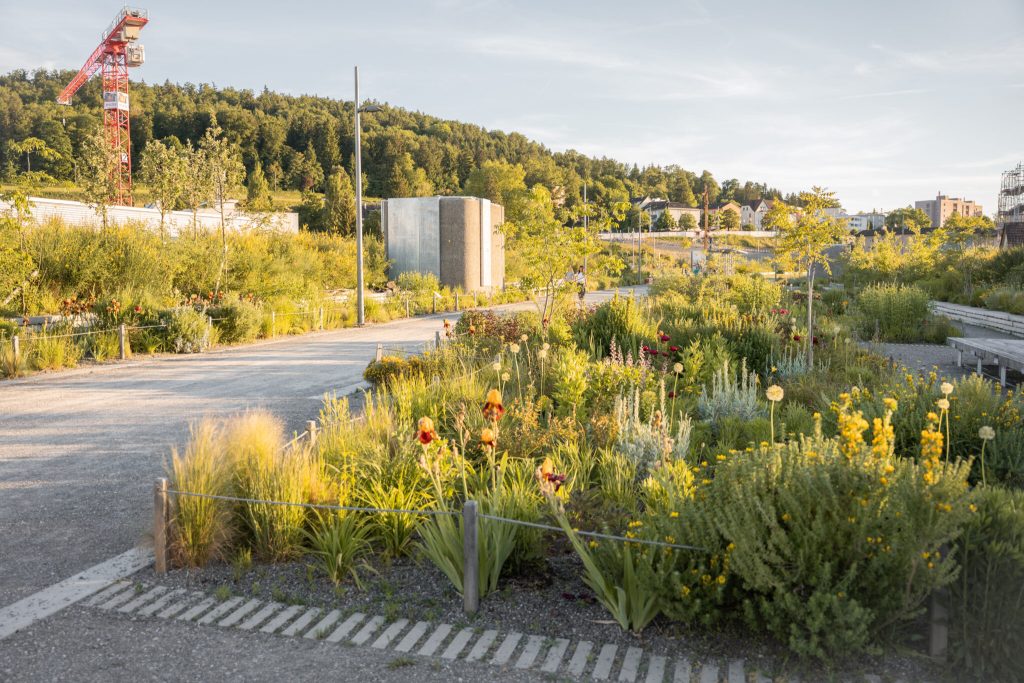
The site conditions are harsh. In some places, the soil layer is only 32 centimeters deep. This is compounded by intense sunlight, strong wind exposure, and extreme temperature fluctuations. Such extreme sites are particularly valuable for biodiversity. As “Grün Stadt Zürich” documents, nutrient-poor areas of this kind have become rare. Scientific research was essential to the project’s success. Approximately 400 predominantly native trees were planted, supplemented by climate-adapted species from southern European dry forests and steppes. In addition to classic shallow-rooted species, “Grün Stadt Zürich” also experimented with exotic species. The selection of plants was based on proven principles. It included specimens from the Valais and the Jura, species from the nutrient-poor soils and rocky slopes of the Uetliberg, as well as hedges of sea buckthorn and wild rose. Hundreds of plant species now provide habitats for insects, birds, and small mammals. Custom-designed, wild-bee-friendly wall elements—constructed using dry-stone techniques with special bee sand—are set to become Switzerland’s largest bee hotel. Structures such as deadwood islands, stone piles, and dry stone walls were specifically created. Ongoing fauna monitoring documents which species can thrive in the long term under the prevailing conditions. A wide variety of wild bee species, as well as butterflies and moths, have already been recorded. Dragonflies from the adjacent Glatt River area hunt here. Wren and white wagtails have found nesting sites.
A Place for Dialogue and Social Gathering
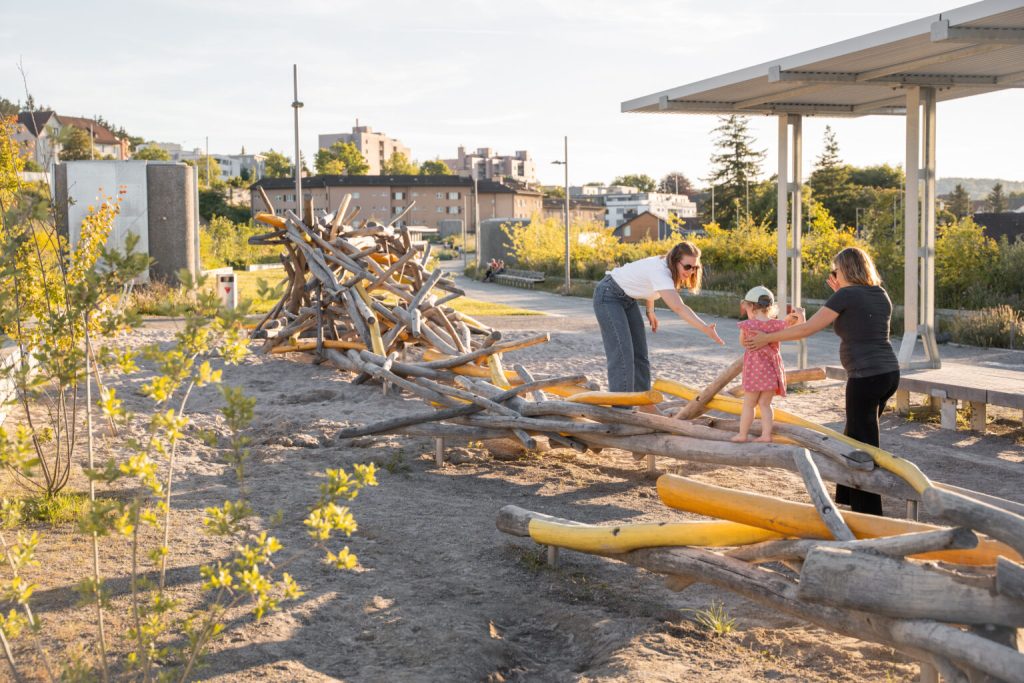
Ueberlandpark is a neighborhood gathering place. Two playgrounds invite children and their families to play. There was strong demand from neighborhood residents for accessible meeting places, dining options, and high-quality outdoor spaces for hot days. A dialogue process involved the neighborhood community. Participants in the discussions included property owners, the Hirzenbach Community Center, and neighborhood associations.