

A grant-making framework makes a foundation’s grant-making practices digitally readable. It translates the foundation’s mission, funding priorities, criteria, exclusions, and preferences into a structure that provides guidance to people and can be utilized by digital systems. This results in effective grant-making practices: less time spent searching, more suitable applications, and clearer preliminary reviews. And more time for what foundations and nonprofits actually want to achieve: creating impact.
Grantmaking rarely begins with checklists. It begins with an idea of what should change. What does a foundation want to make possible? Which social development should be strengthened? Where does it contribute—and where does it not?
In practice, this isn’t possible without checklists. For this approach to translate into actual support, it must be articulated in the form of foundation missions, regulations, websites, and annual reports. From the funding organization’s perspective, this information is often clearly and consistently formulated. For applicants, however, it can be more challenging to bring these various sources together, combine them with practical experience, and ultimately interpret them correctly.
This is exactly where the funding rationale comes into play.
Support cannot be reduced to buzzwords
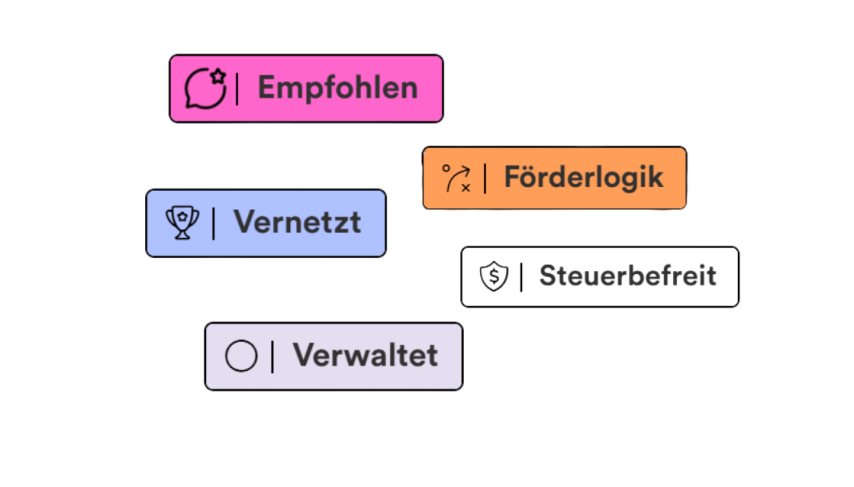
The funding logic brings together objectives, priorities, mandatory and recommended criteria, exclusions, typical forms of funding, and context-dependent differences in a structured presentation. This captures what is often difficult to grasp in reality: the actual logic behind a funding decision.
This is particularly important because funding rarely works in a binary way. Many decisions depend on the specific context. A foundation’s funding focus often varies by region: for example, in Switzerland it supports social causes, whereas abroad it focuses exclusively on emergency aid projects. Or a foundation may attach different conditions to its various focus areas: on the one hand, it supports students in financial need, and on the other, it supports tax-exempt arts institutions in the region.
Such nuances can hardly be accurately captured in the standard model of a classical categorical classification. In a funding framework, however, they can. It specifies which conditions are mandatory, which characteristics strengthen a project, and where clear boundaries lie. This provides a more precise picture than any list of keywords could.
The funding logic thus serves as a kind of translation of the strategy into practice. It transforms policy documents, websites, regulations, funding examples, and practical knowledge into a structure that can be applied in day-to-day work. It is read by people, teams, and foundation boards—and, where appropriate, by digital systems as well.
From Searching to Categorizing
For nonprofit organizations, this fundamentally changes the way they search for funding.
Traditional research often results in long lists of seemingly relevant funding organizations. Then the real work begins: reading websites, comparing guidelines, looking for exclusion criteria, interpreting past funding examples, noting ambiguities, and setting priorities. Much of the effort isn’t due to a lack of information, but rather because the information isn’t organized in the same logical framework needed to prepare decisions.
Funding logic doesn’t just shorten this path. It improves it.
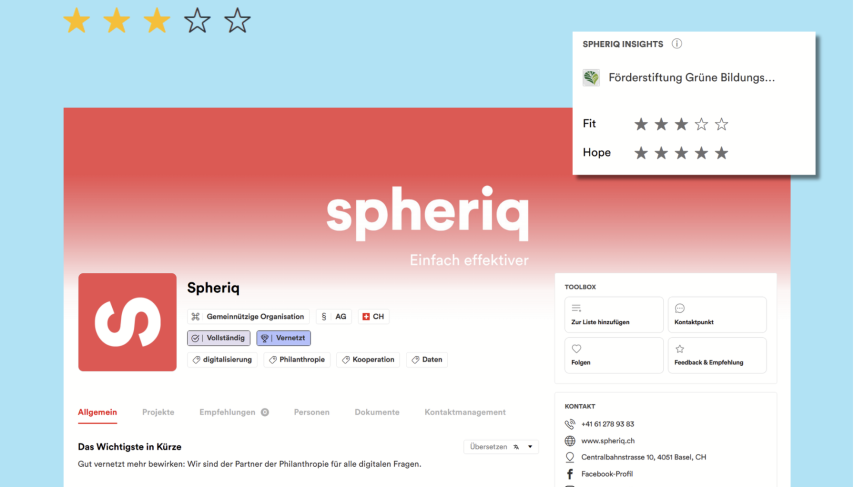
For nonprofits, this introduces a new dimension to grant research. They are no longer just looking for thematic matches; instead, they receive early indications of whether a project even fits within a funding organization’s mission. This changes the process leading up to the application: a long list of potential funders is transformed into a prioritized assessment. Hope turns into direction. Scatter loss turns into focused preparation.
The funding logic thus helps to categorize a project. It shows where there is a strong fit, where questions remain, and where exclusion is likely. This protects applicants from wasting time and effort. And it protects funding organizations from receiving applications that, while seemingly thematically relevant, fail to meet key criteria.
Good grant-making logic is therefore not simply an additional data point. It represents a significant improvement in the quality of the relationship between grantors and applicants.
Funding organizations also benefit
From the perspective of funding organizations, the primary purpose of funding logic is to ensure that the organization is better understood. This also makes internal work easier. A clearly defined funding logic establishes a common language for the executive office, committees, and the board of trustees. During the preliminary review, it becomes clearer more quickly whether an application is eligible. During discussions, it becomes clearer whether an application is merely thematically relevant or truly aligns with the foundation’s core funding objectives. And in the decision-making process, assessments can be better justified. In short, this reduces friction in the process: fewer inappropriate applications, less room for interpretation. Many foundations are familiar with this problem: they receive applications that are somehow connected to the foundation’s purpose but do not align with its own funding practices. This is rarely due to a lack of diligence on the part of the applicants. Often, it is because the key distinctions are not sufficiently clear.
A funding organization may publicly state that it supports dementia projects. But what does that mean exactly? Are research projects also supported? If so, which ones? Are local projects of interest? Under what conditions? What role do partnerships play? What is excluded, even though it might be thematically related?
The more precisely these principles are formulated and documented, the easier it is to distinguish between a general thematic similarity and an actual fit.
In this way, grant-making logic also becomes a tool for positioning. It helps a foundation not only to clarify its grant-making approach internally, but also to make it digitally compatible—not as a rigid set of rules, but as a robust description of what really matters.
In a digital grant-making environment, this resilience becomes crucial. After all, digital systems are only as good as the logic on which they are based. Unclear grant-making logic results in unclear recommendations, even in a digital context. Precise funding logic, on the other hand, enables better triage, better preliminary review, better communication, and better collaboration. Thus, funding logic becomes the “missing link” between strategy, grant application management, and impact.
What constitutes sound funding logic?
A good funding rationale is as short as possible and as long as necessary. Its quality is reflected in how precisely it captures a foundation’s funding philosophy, making it possible to reliably assess whether a project is a good fit.
This requires clear distinctions between mandatory, desirable, and exclusion criteria. Mandatory criteria should specify only what is truly essential. Desirable criteria indicate what makes a project particularly suitable. Exclusion criteria define the limits of funding. If these levels are mixed, the result is either arbitrariness or a framework that is too narrow, which hardly any project can fully meet.
Effective funding logic therefore relies on well-defined terminology. Terms such as “innovative,” “relevant,” or “high-quality” must be clarified. Key factors include a specific target group, a clear practical relevance, a precisely identified funding gap, requirements regarding collaboration or local roots, and a realistic prospect of impact.
It is equally important to clearly define the funding areas. Having multiple funding priorities is only helpful if they actually represent clearly delineated areas. However, if they overlap too much, classification becomes unclear and funding becomes more arbitrary.
A sound funding rationale translates funding principles into transparent and unambiguous criteria. It clarifies what is essential, where there is flexibility, and where funding is fundamentally inappropriate. This is precisely what makes it the foundation for better recommendations, clearer expectations, and more informed decisions.
Greater precision does not mean less humanity
Funding logic does not replace a funding decision. Nor does it preempt human judgment.
On the contrary: it highlights where human judgment remains particularly important. After all, when criteria are defined more clearly, matters of discretion become more apparent. Is the practical relevance sufficient? Is a local project truly transferable to other regions? Is a collaboration substantive or merely formal? Is there truly no other source that can bridge a funding gap?
The funding logic, therefore, does not automate responsibility but rather improves the preparatory process. It reduces noise, makes assumptions more explicit, and creates a common foundation for more informed decisions. This is precisely why a clear funding logic aligns well with responsible digital philanthropy. The machine can sort, compare, provide guidance, and highlight contradictions. But it does not decide what is important. It does not replace discussions about impact, stance, or risk. It merely creates a better starting point for those discussions. People remain in control—but with a clearer focus.
From Information to Guidance
When funding logic becomes available across the entire sector, it changes more than just individual funding searches. It creates a new level of transparency in the interaction between funding organizations and implementing partners. Applicants understand sooner where it’s even worth submitting an application. Funding organizations receive more relevant inquiries. And platforms like Spheriq can provide recommendations not only based on topics but also on actual fit. Funding logic creates a common language for funding.
Funding Logic Check
Many funding criteria are still too vague, too broad, or not consistent enough in their everyday application. With the Funding Criteria Check, Spheriq helps funding organizations make their funding criteria digitally compatible.
In this compact workshop, we will focus in particular on:
• whether the funding areas are clearly defined and facilitate the routing of applications
• whether mandatory, desirable, and exclusion criteria are clearly separated
• whether the scope of impact, target groups, funding types, and exclusions can be unambiguously assessed
• whether there are enough specific desirable criteria to distinguish strong applications from less suitable ones
• where terms, criteria, or processes leave too much room for interpretation
The result is a brief assessment that includes specific suggestions for improvement and a Quality Score for the current grant-making process. We discuss and implement these improvements together, with one simple goal in mind: fewer unnecessary applications, clearer preliminary reviews, better team discussions, and more informed decisions by the Foundation Board.