
Grant-making foundations and NPOs pursue the same goal: effective charitable work. Nevertheless, misunderstandings, frustration and high administrative costs often arise in foundation fundraising. Carola Büchel, consultant for non-profit organizations, explains why good contact management is crucial for successful funding relationships.
Carola Büchel, you support non-profit organizations (NPOs) and grant-making foundations in fundraising. How would you describe the “relationship” between the two today?
First of all, I would like to express my respect for people who donate part of their private or business assets to a foundation to pursue charitable causes. This is anything but a matter of course. It is often not just a matter of financial support, but also a genuine sense of social responsibility.
This creates stable relationships!
The relationship between grant-making foundations and NPOs is therefore fundamentally valuable, but also challenging. Both sides want to enable effective charitable work. But both sides have a different starting point and information situation in terms of money, knowledge and specific expertise. As a result, I often observe that expectations and requirements diverge or are not expressed openly enough, which can lead to misunderstandings or additional work.
The relationship between grant-making foundations and NPOs is fundamentally valuable, but also challenging.
Carola Büchel, consultant for non-profit organizations
Many NPOs invest an enormous amount of time in applications, reporting and formalities. Why is this the case?
They often do not know exactly what a foundation is really looking for or does not want to support. They therefore try to present their work as comprehensively as possible. They write general applications, project-specific applications and detailed reports in order to convey a complete picture. This is understandable, but involves an enormous amount of effort. At the same time, many foundations also have limited resources.
To what extent do funding criteria influence how NPOs plan their projects?
Very strong. Over the last few years, I have supported around 35 NPOs in the areas of visibility, communication and fundraising. I have seen time and again how strongly funding criteria influence project planning. Many organizations already consider the following at the design stage: What costs can we even submit? How high can personnel costs be? Are administration costs desirable or rather critical? This sometimes leads to organizations splitting their offers more into projects because project-related funding is easier to finance than ongoing services or infrastructure.
Administrative costs and the flexible use of funds are often sensitive issues. Why do many funders find it difficult to be more open here?
One of my favorite topics! In conversations with foundation board members, I often hear the attitude: “The money should go as directly as possible to the people affected.” This desire is absolutely understandable, especially in social projects. At the same time, however, people underestimate what it takes for NPOs to do effective and professional work: good employees, fair wages, administration, IT, communication and training. Nevertheless, many foundations prefer to support specific projects rather than organizations or flexible funds. This sometimes leads to organizations having to package ongoing offers or support services into “projects” so that they can be funded at all. This is exhausting in the long run and often not very effective.
That means?
If a foundation trusts an NPO to use project funds responsibly and purposefully, why not also use flexible funds? Clear reporting can also be required for this. After all, trust and transparency are not mutually exclusive. I would therefore like to see this understanding develop further: Impact is not only created in individual projects. Impact is also created by stable organizations with good structures, committed employees and a professional basis.
Impact is not only created in individual projects. Impact is also created by stable organizations with good structures, committed employees and a professional basis.
Carola Büchel, consultant for non-profit organizations
However, subsidies with many conditions are widespread. So you have to ask yourself whether it’s worth the effort to submit an application?
Yes, to be honest: I recently saw a 10-page online application from a foundation that I deliberately didn’t fill out because the effort involved was disproportionate to the potential funding amount of CHF 3,000. This does not mean that the requirements are wrong. Grant-making foundations must be able to carefully check where their funds are going. Nevertheless, both sides benefit when processes are clear, efficient and realistic.
Where do you see the biggest differences in the expectations of both sides?
Many NPOs now work very transparently – and rightly so. They disclose strategies, budgets, challenges and impact goals. This makes it all the more disappointing when there is no response to a request or very little communication. Many organizations would like more clarity here. This also includes finding out why an application was not considered in the event of a rejection.
On the other hand, grant-making foundations often receive a large number of applications that do not fit in with the foundation’s purpose. In some cases, applications are widely scattered or submitted without in-depth consideration of the foundation. According to the motto: “Maybe it fits somewhere.” This is not professional on the part of the NPOs and increases the workload for the funding foundations enormously. More care and better communication would therefore help both sides. Quality is more important than quantity in foundation fundraising.
Another important point is the ability to plan.
Many NPOs want longer-term partnerships in order to be able to develop services sustainably. Grant-making foundations, on the other hand, often want to remain flexible and not commit themselves for years. These different needs sometimes mean that organizations have to start from scratch every year, even though important services are actually intended for the long term.
Foundation fundraising as a “cat-and-mouse game”?
In part, yes. The “cat-and-mouse game” can be seen where NPOs try to tailor their projects as precisely as possible to the requirements of individual funding foundations, while funding foundations are constantly refining their criteria, evidence and processes. This sometimes gives the impression that it is not so much the idea itself that is decisive, but rather how professionally an application meets the foundation’s expectations. Many NPOs nevertheless accept these framework conditions because they are dependent on funding.
Is the solution more partnership-based cooperation instead of selective support?
Both can work well if expectations and processes are clear. Purely transactional support relationships can also be efficient and pleasant. Sometimes they are even easier because they are less time-consuming. You know the funding criteria, submit an online application, receive a grant and send a report the following year – done.
But for me, partnership relationships go one step further. Projects are not always linear and needs change. You can (and should!) openly discuss difficulties or changes. Only then do trust, space for exchange and sometimes courageous or innovative ideas emerge. Or it becomes possible to request support for organizational development, further training or employee training. In other words, topics that contribute enormously to the quality and impact of the work, but often only indirectly benefit the target groups. They are more difficult to finance than traditional projects. This is precisely where I see the difference between purely transactional funding and a genuine partnership.
Important fundraising information is often obtained in passing: in conversations at events, through previous cancellations or personal assessments of an organization. What role does this informal knowledge play in institutional fundraising?
A very big one. I encourage all my clients to write down such feedback so that this knowledge is retained in the organization. The exchange between fundraisers is also extremely valuable. Many know from experience which foundations are a good fit for which projects or how certain processes work. This knowledge helps organizations to use their resources in a more targeted way and avoid unnecessary effort. That’s why I think exchange platforms, specialist groups and industry contacts are extremely important.
I encourage all my customers to write down such feedback so that this knowledge is retained in the organization.
Carola Büchel, consultant for non-profit organizations
How important is professional contact management to ensure that this knowledge is retained even when there are personnel changes?
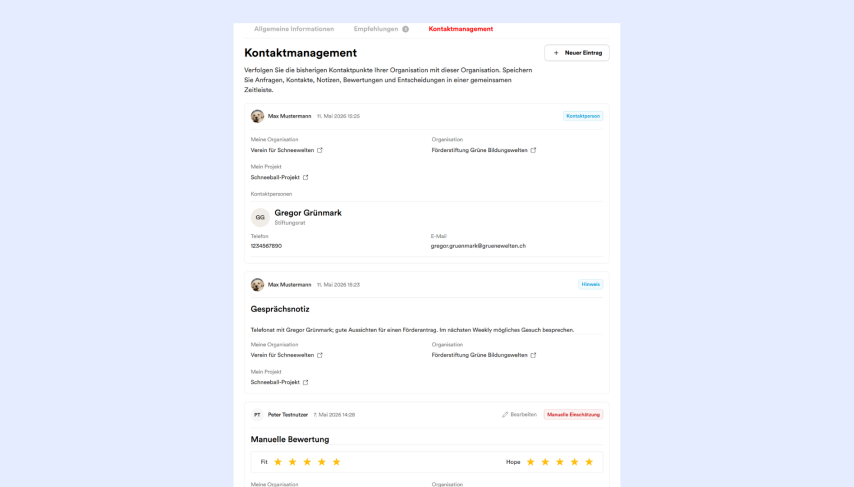
Very important. Organizations should document exactly when they wrote to which foundation, what feedback they received and what next steps are planned. In this respect, many NPOs can still “go the extra mile”. This does not necessarily have to be a complex CRM system. Depending on the size, a well-maintained Excel file will also suffice. The decisive factor is that the knowledge is retained and properly documented. Of course, a single system in which all relevant information is available would be great!
What do you wish for the future of foundation fundraising?
I would like to see openness, exchange and trust between funding foundations and NPOs. Sometimes I observe a certain frustration on both sides. Funding foundations sometimes feel overwhelmed by the large number of applications and requests. NPOs, on the other hand, sometimes feel that they are not seen enough or receive hardly any feedback. As a result, there is still too little genuine equality. Yet both sides are pursuing the same goal: to enable effective charitable work. I believe that informal exchange formats can be a good way to achieve this. Formats where funding foundations and NPOs can get to know each other without any direct pressure to apply. Such encounters can help to break down inhibitions and create more cooperative relationships in the long term. I believe that there is great potential there.
About the person
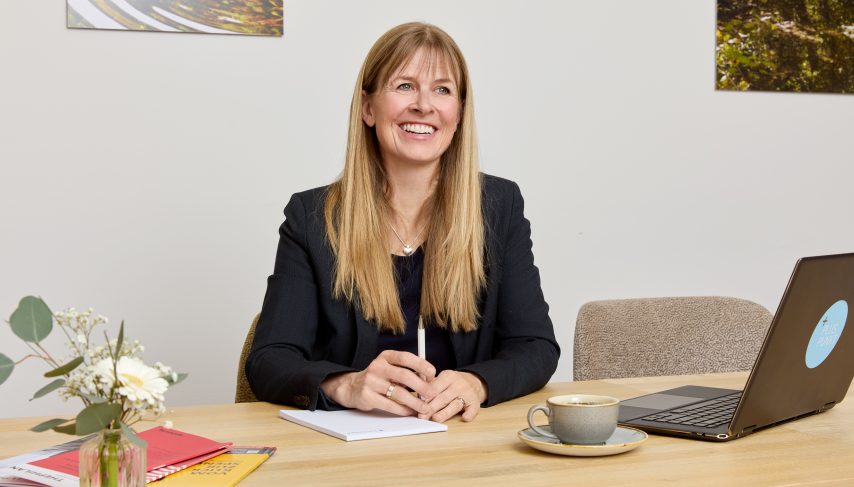
Carola Büchel is self-employed and supports charitable foundations and associations in Switzerland and Liechtenstein with her company in the areas of scouting, visibility, communication and fundraising. She is a business economist, honorary foundation board member and board member of a non-profit association. She completed the CAS Non-Profit and Public Management as well as Governance & Leadership at the University of Basel. She herself worked for several years as Head of Fundraising & Communications at a global children’s aid organization. The 50-year-old is, as she says of herself, “passionately committed to the non-profit sector”.