
A good content match is important. But it doesn’t tell us how realistic a successful connection or collaboration actually is. This is exactly where the Hope score comes in. Spheriq has fundamentally refined the calculation of the Hope score. In this post, we’ll show you how we calculate it.
Anyone who has researched suitable funding organizations is familiar with this situation: At first glance, two foundations may seem equally promising. Both support the right cause, both are active in the right region, and both target the desired audience.
Nevertheless, the starting point can be completely different.
For one foundation, current funding opportunities are well-known, the application process is clearly described, and other organizations report positive experiences. For the other, little is known about its current funding practices, or it isn’t accepting applications at all right now.
Thematically, both may be a good fit. Nevertheless, the prospects for a successful next step are not the same.
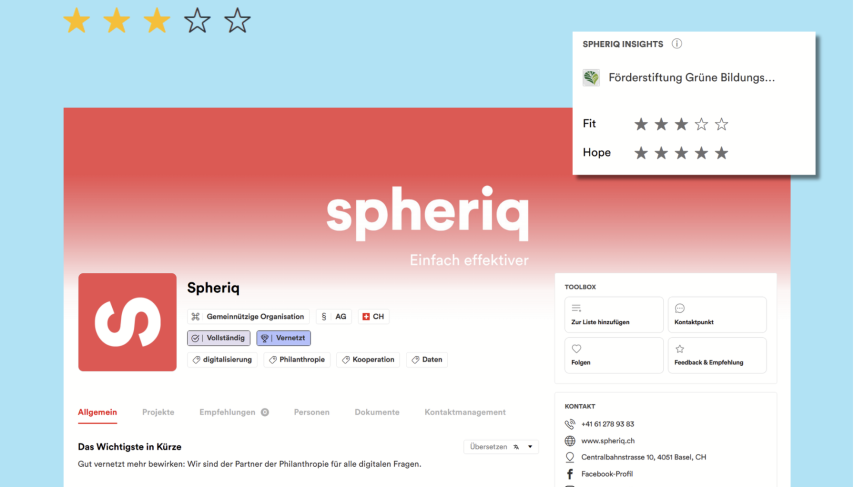
Hope is designed to make precisely these differences more visible. Instead of summarizing limited information into a rough overall picture, Hope now takes into account various indicators related to activity, funding practices, accessibility, and community experiences. The result is a more nuanced rating on a scale of 0 to 5 stars, which serves as a useful guide for the next decision.
Two Scores, Two Different Questions
Fit and Hope were originally developed as two complementary guides. With the new calculation method, this division of roles is now even clearer.
Fit answers the question: Is this organization or project generally a good fit for me?
Yara Ouertani, Data Quality & Marketing at Spheriq
The “Fit” assesses the fundamental compatibility: how well two organizations—or a project and a funding organization—align. To this end, subject areas, target groups, and geographic areas of impact are compared in particular.
Hope, on the other hand, addresses the question: What indicators suggest that establishing contact or forming a partnership could be realistic and promising?
Yara Ouertani, Data Quality & Marketing at Spheriq
Hope is quite different. It provides an indication of whether it might be worth reaching out by analyzing relevant signals. These include, above all, the organization’s availability and past experience. For example, whether or not there is a known history of specific funding.
As a result, Hope is now calculated independently of the Fit. A high Fit does not automatically lead to a high Hope, and a low Fit no longer lowers Hope.
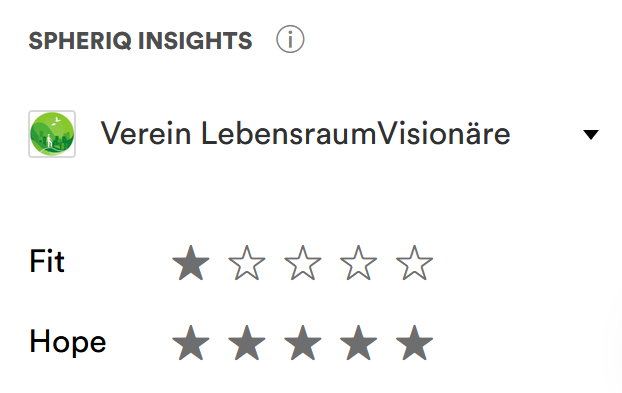
This provides a more nuanced picture. After all, a foundation may be an excellent fit for a project but at the same time be difficult to reach or not currently accepting applications. Conversely, an organization may be very active, transparent, and easy to reach, even if it is not the right partner for the specific project in terms of its mission.
Only when both values are considered together do they provide the necessary guidance.
Hope Is Building a Stronger Foundation
A more nuanced distinction is also being made within Hope. Instead of quickly classifying organizations on the same level based on just a few criteria, the score is now based on several weighted positive and negative indicators.
The following factors are taken into account in particular:
- Current activity: Is the organization active on Spheriq, and is its account actually being used?
- Documented funding activity: Are there any known specific grants or confirmed funding?
- Clear application processes: Is it clear whether and how a funding organization should be contacted?
- Recommendations: Are there confirmed recommendations from other stakeholders?
- Feedback from the community: Positive experiences have a positive impact, while negative experiences have a correspondingly negative impact.
- Profile quality and completeness: A well-maintained and comprehensive profile provides additional guidance. For funding organizations, we also consider whether a funding rationale has been provided.
Ultimately, the various signals are combined into a single score and rounded to a Hope rating on a scale of 0 to 5 stars.
Missing information is not the same as negative experiences
The new calculation also changes how a low “Hope” score is interpreted.
A low Hope score does not automatically mean that other organizations have had bad experiences. It can just as easily mean that there is simply not enough reliable information available yet: no documented grants, hardly any feedback, no recommendations, or a profile that has not yet been fully updated.
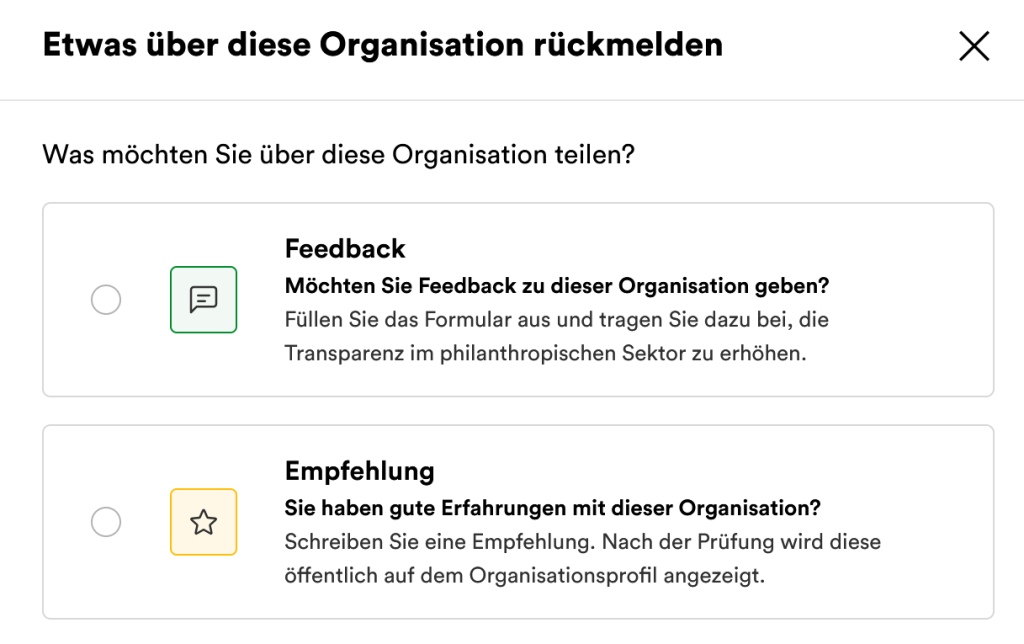
The value of the Hope score increases with the quality and quantity of available information. This does not constitute a promise of success, but rather a realistic assessment of the initial situation as a basis for an informed decision.
A clear application process is key
A question of particular relevance to nonprofits is whether a funding organization is even willing to accept grant applications.
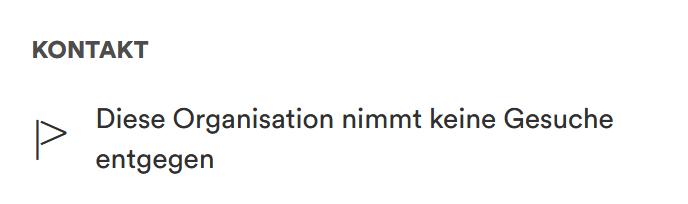
That is why Hope now also takes into account whether a foundation has clearly outlined its application process. If it is clear how to submit an application or how to contact the organization regarding this matter, that is a positive sign: applicants have a concrete next step to take.
Conversely, if a funding organization explicitly states that it does not accept applications or does not wish to be contacted regarding funding requests, this will be taken into account accordingly. This information is also valuable because it prevents precious resources from being spent on a futile application.
This, too, is an important form of guidance. After all, a foundation may be active, support exciting projects, and maintain an excellent public image, but if it does not accept unsolicited applications, this should still be taken into account when prioritizing funding opportunities.
Hope thrives on an active sector
At the same time, the new analysis shows why up-to-date and shared information is central to the entire nonprofit sector and valuable to all stakeholders.
Documented grant-making makes actual funding practices more visible. A recommendation indicates that collaboration has taken place. Constructive feedback supplements the formal details of a profile with practical insights. A well-defined grant-making rationale makes it clearer what a foundation is actually looking for.
As a result, individual pieces of information gradually come together to form a more meaningful overall picture.
Both sides benefit from this: nonprofits can better prioritize their research and reduce unnecessary effort. Funding organizations, in turn, can use clear information to better communicate how they work, what types of requests they welcome, and when it makes sense to reach out. As a result, funding organizations receive more relevant applications and can also minimize their own workload. In other words: the flood of applications is reduced.
Better Indicators Instead of Supposed Certainty
Even with the new calculation, Fit & Hope are not intended to predict funding decisions. A partnership cannot be reliably reduced to a five-star rating. Personal discussions, strategic priorities, available funds, and the specific timing remain decisive.
The strength of the metrics lies elsewhere: they condense a wealth of individual information into an initial guide.
With the improved Hope, this guidance becomes more precise. Fit shows where there is a basic match. Hope indicates where additional signals point to a promising next step.
Two different questions—and thus two metrics that, together, help us focus our time and attention where they can have the greatest impact.