Are you looking for grant-making foundations for your project? With the Spheriq search tool, you can quickly find some initial foundations that might be a good fit for your project. Now the question is: Which ones are truly suitable? And which ones should you approach first?
Many people start with the large, well-known foundations. These receive thousands of applications, and the competition is fierce. However, smaller, lesser-known funding organizations that are a perfect fit for your project can also be interesting partners. They’re harder to find, but fewer organizations apply to them.
In four steps, you can go from your initial search to a shortlist of promising funding partners.
1. Search: Make multiple attempts instead of just one search
A single search rarely finds all relevant foundations. Therefore, perform multiple searches using different terms: for a hospice, for example, use synonyms such as “palliative care” and “end of life,” as well as broader topics like “health.” Narrow down each search using the topic filter. As a rule of thumb, limit each search to no more than 500 results; otherwise, the results will become too overwhelming to review. Starting with the “Starter” plan, you can also filter by area of focus, target group, or canton.
The article “Finding the Right Foundation—Without a Long Search” shows you how to search more precisely using search operators and filters. You’ll find additional guidance in the tips for good search results.
2. Reviewing Results: Your Long List
Now go through the results. Start by taking just a quick look at the foundations you found. For each foundation, a brief review of three things is sufficient:
- Focus: Does the foundation’s mission generally align with your project?
- Region: Does the foundation provide funding in the area where your project will be implemented?
- Target audience: Are the people you want to reach among the potential beneficiaries?
The key question here is: Could this be a good fit in principle? If there’s a clear match or if you still have questions, add the foundation to your long list. It’s better to include one too many than to eliminate one too soon. If a foundation is clearly ineligible, you can leave it off the list.
For each foundation on the long list, briefly note the following:
- Who: Contact information and, if available, a contact person.
- Why: Why she might be a good fit.
- How: Application process and deadlines, to the extent they are already known.
That way, you’ll still know in a few weeks why a foundation is on the list.
Starting with the “Starter” plan, you can compile a list of interesting organizations directly from your search results and gradually add to your selection later.
3. Review and Select: Your Shortlist
Now take a closer look at each foundation on the long list. Four questions will help you do this:
- Application Process: Does the foundation even accept external applications? Some only carry out their own projects. Is there an application form or a deadline? Whether a foundation welcomes unsolicited applications is indicated in its Spheriq profile, if the foundation has specified this itself.
- Funding criteria and exclusions: Does your project fall under “What We Do Not Fund”? For large foundations, the current funding priorities carry more weight than the foundation’s general mission.
- Funding History: Has the foundation previously supported similar organizations or projects?
- Grant Amounts: Does the typical amount meet your needs? Some foundations award 2,000 CHF, others 200,000.
Many smaller foundations do not have their own websites. In that case, the profile on Spheriq is your most important source of information.
Now there are two key considerations: How well does the foundation fit your project?
- How realistic is the prospect of receiving funding?
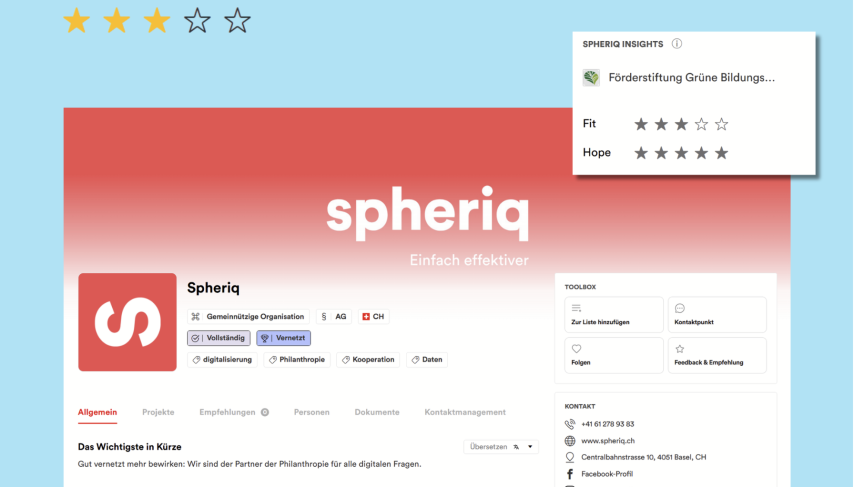
Starting with Pro, the “Fit” and “Hope” metrics help you with this. They provide an assessment of the thematic fit and the prospects for funding. The results help with prioritization but do not replace your own evaluation.
Classify the foundations into A, B, and C:
- A – Particularly promising: Good fit, no apparent exclusions, and a suitable application process.
- B – Interesting: Generally a good fit, but important questions remain unanswered.
- C – Backup: Significantly lower fit or unfavorable conditions.
One question can help you make a decision: If I were this foundation, would I support our project?
Your shortlist should include 5 to 10 foundations: primarily those in Group A, supplemented as needed by the strongest candidates from Group B. Contact them or submit a grant application.
4. Make contact: where possible and appropriate
Not every foundation wants to be contacted before a grant application is submitted. Whether it makes sense to reach out before submitting an application depends on how the foundation is organized:
- With an administrative office: You can identify them by their own website, which includes funding guidelines. The administrative office is usually happy to provide information; it’s worth giving them a quick call or sending an email.
- Without an administrative office: Small foundations or those managed by a trustee often do not have a website or a designated contact person. In these cases, send a complete application directly by mail.
If a foundation states that it does not wish to be contacted, it is best to respect that request.
When contacting us, keep it brief and to the point. Describe your project, the funding you’re seeking, and any questions you’d like to clarify before submitting your application. Always specify a specific amount. Anne Oesterlin explains how to turn this into a compelling application in her article “What Makes a Good Application.”
After each contact, make a note of what you’ve learned and what comes next. With Spheriq’s contact management, this information remains directly linked to the respective funding organization. Starting with the Pro plan, you’ll also receive reminders to ensure that important next steps don’t fall through the cracks.
And if the first round doesn’t yield enough results: Pull out the long list again and put together the next short list.
From Real-World Experience: Hospice Oberwallis HOPE
Caroline Walker Miano, Executive Director of the Upper Valais HOPE Hospice, conducted targeted research on potential funding partners.
Using search terms such as “palliative care” and “end of life,” she identified potential funding foundations. She then reviewed the foundations’ profiles to assess their mission, funding criteria, and exclusions. Instead of sending out mass mailings, she prepared individualized proposals. In this way, she identified and contacted about 15 foundations. The total amount raised was approximately CHF 300,000.
Her most important lesson: Specifying a concrete amount increases the chances of securing larger grants.
Read the full case study
Checklist: Is your shortlist ready?
Before you contact the first foundations or prepare grant applications, check the following:
- Have I searched using different keywords and appropriate filters?
- Do the selected foundations generally align with my project’s topic, region, and target audience?
- Have I reviewed the current funding criteria, exclusions, and application procedures?
- Can I explain why I’m prioritizing these particular foundations?
- Have I selected my first five to ten funding partners and noted down the most important information?
- Do I know, for each foundation, whether the next step is to submit a preliminary inquiry or a direct application?
Get Started
Start your long list now.
Open the search function, start a search, and compile a list of organizations that are generally a good fit for your project.
With Spheriq Starter, you can view all search results, use all filters—such as area of operation, target groups, or canton—and manage your long list directly as a list on Spheriq.
We’ll demonstrate the search features live in our free webinar, “Introduction to Research.”
Practice with your own project: In the online workshop on foundation research, you’ll walk through every step of the process using your own project—from self-analysis to search strategy to a shortlist with evaluations—and receive personalized feedback.