A new fundraiser is starting her job. She is handed an Excel list of 200 foundations, some of which are marked without any explanation. At the same time, a grant application is sitting on the desk at a grant-making foundation. The organization had been there once before, three years ago, but no one remembers what was discussed back then.
Both situations stem from the same root cause: Knowledge about a relationship was tied to an individual, not to the organization. A CRM for nonprofits won’t change that on its own. However, it does help if the team uses it according to simple rules. These rules are the focus here, for both fundraising and grant-making foundations.
What Belongs in the CRM and What Doesn’t
A good contact CRM is not an address book. It tracks the status of a relationship and what happens next. For most organizations, five things are usually sufficient:
- Point of contact and role: Who makes decisions, who handles the preparation, and who is the first point of contact?
- Timeline: Conversations, requests, acceptances, rejections, with dates and a brief description of the content.
- Assessment: How well do we match? A simple scale is sufficient—for example, high, medium, low.
- Reasons: Why was an offer declined, and why was one accepted? This information is most valuable for next time.
- Next step: What needs to be done, by when, and who is responsible?
You should omit anything that isn’t necessary for the relationship: personal details, speculations about people, and confidential information from conversations. When recording personal data, comply with the Swiss Data Protection Act. A good rule of thumb: Write only what you would be willing to show to the person concerned.
Fundraising Perspective: From the Initial Contact to the Follow-Up Request
In fundraising, every relationship with a foundation goes through similar phases. It helps to keep these phases in mind and to record the current status as a note or entry:
- Research: The foundation seems like a good fit on paper. Note down why.
- Initial contact: Phone call or email before submitting the request. Note down what you learned, such as deadlines, areas of focus, or budget limits.
- Application Submitted: Date, amount, project.
- Decision: Approval or rejection, with reasons, if known.
- Acknowledgment and Report: When is the report due, and who will write it?
- Follow-up application: When can a new application be submitted?
Two habits make the biggest difference. First: Always document the reasons for a rejection, even if they’re only implied. Second: Immediately note deadlines and blackout periods. That way, even years later, colleagues will know when it’s worth making another request.
The Granting Foundation’s Perspective: Scouting and Support
Granting foundations need CRM from a different perspective. They aren’t looking for money, but rather for suitable organizations and projects. And they often support grantee organizations for years.
- Scouting Candidates: Organizations that have caught your attention, along with a brief explanation of why they might align with your grant-making mission.
- Meeting notes: What did you learn during visits, events, or phone calls? Who was present?
- Funding History: Which projects have you supported, with what amount, and in which year?
- Reports and Impact: What reports have been received, and what did they reveal?
- Team Assessment: How does the Board of Trustees view an organization? Document this so that decisions remain transparent.
This creates a picture that goes beyond individual grant applications. It forms the basis for partnerships rather than one-off transactions.
Prioritizing: Not all relationships are equal
If you try to nurture every foundation or organization with the same level of intensity, you’ll end up not nurturing any of them properly. Therefore, divide your relationships into three groups:
- A: A few relationships that are key to you. It’s worth maintaining regular, personal contact with these people, even without a specific request.
- B: Relationships with potential. Keep an eye on them and reach out when the opportunity arises.
- C: Casual contacts. For these, it’s enough to note down the essentials.
This classification isn’t set in stone. Review it once a year, for example, during your annual planning.
Maintaining Relationships After a Decision
Many relationships end once a pledge has been made, yet that’s when the real work of nurturing the relationship begins. In fundraising, this means: expressing gratitude promptly, providing reports on time and in concrete terms, inviting people to events, and sharing updates on progress along the way. Those who work this way won’t be writing their next grant proposal to strangers.
For grant-making foundations, the opposite is true. A brief explanation when a grant is denied helps organizations tailor their next applications more effectively. And a discussion following the report often reveals more than the report itself. In both cases, make a note of what was agreed upon and what actions will follow.
Routines That Work
A CRM is only as good as how well it’s maintained. Three simple routines are enough:
- Two minutes after every contact: Make an entry immediately after the conversation or email. One sentence is enough. If you wait until Friday, you’ll have forgotten half of it.
- A Weekly Review: Go over your most important relationships once a week. What’s coming up, and what’s been left undone?
- Team Rules: Decide who manages which relationships and how you’ll write entries—for example, always including the reason and outcome in the first sentence.
The team rules are the most important point. Without them, everyone will use their own system, and the CRM will become just another Excel spreadsheet.
If you’d like, take a look once a year at two or three simple metrics: What’s the approval rate? How long does it take from request to decision? Which relationships have grown, and which have stalled? A well-maintained CRM provides these answers almost automatically.
The First 30 Days
The most common mistake: People try to transfer all existing data right away and give up after two weeks. A four-step plan works better:
- Week 1, Set Rules: Discuss as a team who will manage which relationships and how entries should be written. Half an hour is enough.
- Week 2, Record A-level relationships: Enter only the most important relationships, including the contact person, last contact, and next step.
- Weeks 3 and 4: Practice Routines: Make an entry after every contact, and review the most important relationships once a week.
- After that: Only add older information when you need it, for example, before a follow-up request or a visit.
After a month, the team has established a consistent workflow, and the CRM is already proving its value. Fundraising expert Carola Büchel emphasizes in an interview on contact management that a well-maintained spreadsheet can suffice to start with. Read about how Spheriq approaches this topic in “The Memory for Fundraising and Scouting.”
Here’s how it works in Spheriq
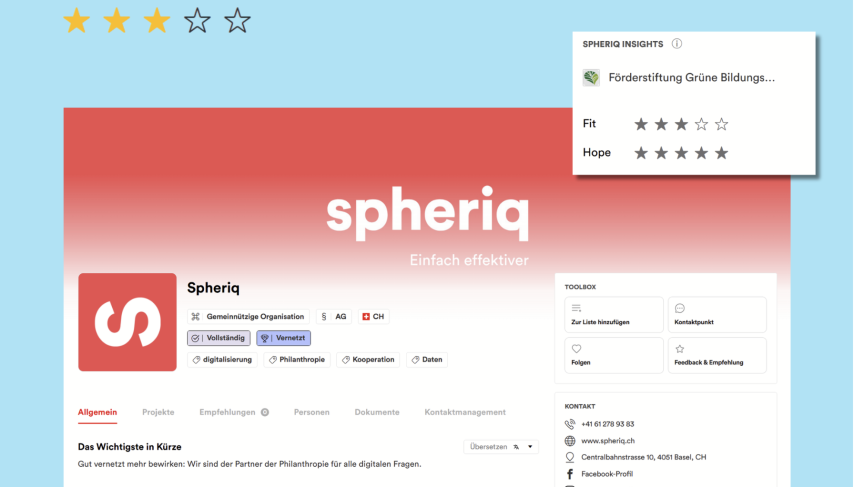
In Spheriq, contact management is directly linked to the organizations’ profiles. You don’t have to enter master data; you simply add your own insights. Private entries such as notes, contacts, rejections, and evaluations are visible only to your organization. Public funding information is visible to both parties if this option is actively selected.
- Starting with Starter: Funding entries with status (open, accepted, rejected) and attachments, contact persons, notes, and your own assessment using the Fit and Hope stars. In your lists, the “Contact Points” column shows the status at a glance.
- Starting with the Pro plan: Reminders notify you or your team via email about upcoming tasks. Smart lists display your contacts and organizations at a glance.
You can find an overview of all features on theSpheriq CRM for Nonprofits page. The article in the Help Center explains how to get started.
Checklist to Take With You
- Per organization: Contact person, history, assessment, reasons, next step
- Classify relationships into A, B, and C, and actively nurture the A relationships
- Always record the reasons for rejections and acceptances
- Immediately note deadlines and blackout periods
- Plan a thank-you note and follow-up report after every acceptance
- Spend two minutes making an entry after every contact
- Review the most important relationships once a week
- Define responsibilities and writing conventions within the team
- In the first 30 days: rules, A-level relationships, routines. Update existing records only as needed
- Record only what you could actually show to the person concerned