
Clima Now is currently holding a public vote to find the best ideas for the food of tomorrow. A multi-stage decision-making process that involves the public is one way to broaden the base of support for the selection of projects. The Culture Committee in Winterthur and CATAPULT in Basel are also taking their own approaches.
Every vote counts. There are currently 14 projects on Clima Now’s Wall of Fame. They all aim to make Switzerland’s future food system more sustainable. An online vote is currently underway to select the seven most compelling projects. These teams will have the opportunity to present their ideas to a jury and an audience at Pitch Night. A total of 90,000 Swiss francs is up for grabs.
The General Public and Subject Matter Experts
“Public voting provides broader support for the selection process and shows us which ideas inspire not only experts but also the general public,” says Corinne Grässle of Clima Now, explaining the advantage of the multi-stage selection process. At the beginning, a jury selects the 14 projects for public voting on the Wall of Fame from all the submissions. “This creates a dual criterion: impact potential as assessed by the jury, and clarity and resonance as assessed by the public,” says Grässle.
“In some cases, the public’s opinion differs from that of the jury—and that is precisely where the added value of the two-stage process lies. The jury primarily evaluates the project’s potential for professional impact, while the public responds more strongly to clarity and emotional resonance. Both perspectives complement each other.” The audience response serves as an initial indicator of a project’s market potential. The extent to which the public can be encouraged to participate in the voting varies from year to year. The key factor is how closely a project relates to the public’s lived experience.
Involve the target audience
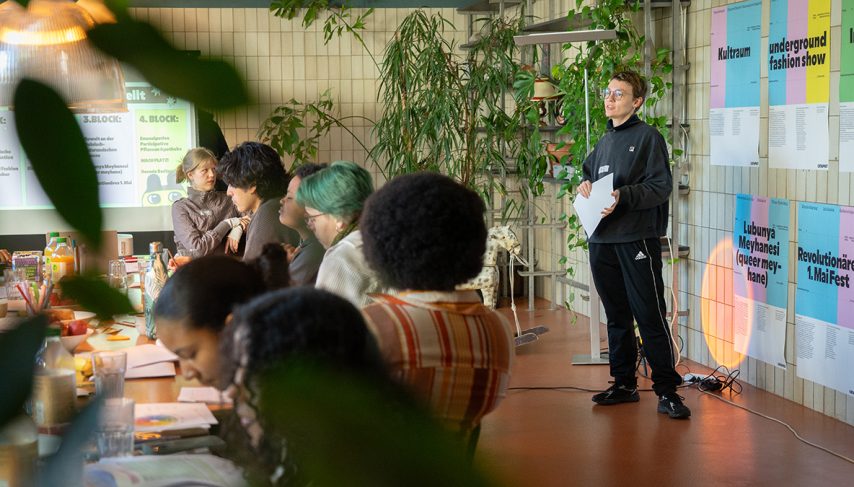
The goal of CATAPULT’s approach is to stay close to the real-life experiences of project organizers. The CATAPULT funding platform, supported by the Botnar Foundation and the Mercator Switzerland Foundation, targets a younger audience. CATAPULT doesn’t just want to fund projects by young people. The entire funding structure was developed and established in a co-creative process with the target group—and even the decision-making bodies consist exclusively of young people. “CATAPULT believes in young people and their ideas—and in the fact that they themselves know best what is missing for them in Basel,” the website states.
CATAPULT operates on two cycles. In the main funding cycle, the organization awards grants ranging from 3,000 to 10,000 francs. At a decision-making event, the young participants discuss which projects they want to support. The group consists of 12 to 20 young people each time. “That’s a good size for decision-making,” says Luan, co-director of CATAPULT. The group is reassembled for each event. Participants come from the community, which has grown over the past five years to include former participants, their siblings and friends, as well as projects that have received funding. “Word of mouth works best,” Luan notes.
Opportunity for project leaders with little experience
In addition, CATAPULT also collaborates with regular classes. The events themselves have also already taken place in schools. This helps keep the community more diverse. If the community were to grow solely through direct connections, there would be a risk of creating a homogeneous group. That is not the case. “We reach different social groups and all age groups from 15 to 25.” In formal educational settings, however, it is more difficult to achieve balanced representation. Luan notes: “We tend to attract young people who have access to high schools and colleges.”
Diverse perspectives are central to CATAPULT. “We start by raising awareness about social justice. We make sure to include a variety of perspectives, and the young people take their responsibility in allocating funds very seriously,” says Luan.
The small grant cycle is currently undergoing a transition. Until now, grants of up to 3,000 francs per project were awarded internally by the team—specifically, by members of the target age group who run the office. CATAPULT lacks the resources to conduct these award ceremonies as part of events. These events are resource-intensive. For this reason, a permanent external group is now being formed to handle them. “This allows for a broader societal perspective,” says Luan. For the small grant cycle this year, a decision-making committee was appointed for a one-year term and will meet five times a year. Thanks to an application process, the committee was able to be composed of a diverse group of members. Especially with the small grant pool, it is important to CATAPULT that project organizers who have little experience with grant applications also have a chance. “When it comes to difficult decisions, we’ve noticed that proposals with a specific focus and clear goals stand a better chance than those that aren’t yet formulated in much detail,” says Luan. In general, it can be said that the decision-making groups function well. They have continued to evolve. “We’ve developed a wide range of tools to help us reach decisions,” says Luan. The funding criteria are also continually adjusted based on insights from the evaluation of the processes.
Quality has improved
Clima Now is also constantly exploring ways to further develop participation. Grässle says, “For us, this is part of the ongoing development of Spotlight.” In recent years, this development has, on the one hand, led to a narrowing of the thematic scope of the projects. This is related to the call for proposals. “While in the early years we would choose a topic and then issue a very broad call for proposals, today the call is preceded by a process lasting several months, during which we work with subject matter experts to define the specific topic and draft the call for proposals.” On the other hand, the quality of the submissions has increased. “Because we don’t simply want to support innovation; rather, we want to provide targeted support where new solutions are actually needed.”
Decision-making body selected by lottery
The entire population of Winterthur constitutes the potential decision-making body for the Culture Committee of the Foundation for Art, Culture, and History (SKKG) in Winterthur. Candidates for the committee are selected through a random drawing. 200 letters are sent out. Recipients are invited to apply to join the committee. For many, this letter is a “sign from fate” that motivates them to get involved, says Andreas Geis, Head of Grants at the SKKG. For others, curiosity was the driving force. They wanted to see how such a project works. Unlike formats such as citizens’ assemblies, the Culture Committee has a decisive advantage: it is not merely advisory. The committee decides on the allocation of funds. Each cycle, the respective committee awards 400,000 Swiss francs in funding. From 2021 to 2026, the Culture Committee has funded a total of 188 cultural projects with approximately 1.9 million Swiss francs.
Although the panel is selected by lottery, “it still does not reflect the composition of the population,” says Geis. “There tends to be a higher number of well-educated, older men who sign up.” However, the age range is usually between 18 and 80. At the same time, Geis emphasizes that a random selection process is not representative in and of itself—and that this is not the goal at all. To ensure that all invitees can participate as easily as possible, the foundation offers support tailored to individual situations: whisper interpreting for those with insufficient language skills, coverage of childcare costs, or financial compensation if self-employed individuals or employees are unable to work their shifts due to the scheduled meetings. Ideally, the panel consists of about 25 members. Two project managers are guiding the process, and five meetings are scheduled. Between 120 and 180 cultural professionals submit their projects for funding at each meeting.
Gain experience and take on responsibility
The SKKG also offers support during the onboarding process. “The time commitment is comparable to that of other volunteer positions; former participants describe it as reasonable and manageable,” says Geis. The support provided in advance—to learn about the process and the responsibilities—is particularly valuable. At the beginning of the process, the committee members develop a funding guide. “It serves as a guide for applicants and as an evaluation reference for committee members,” says Geis. To prevent individual members from employing tactical maneuvers during the evaluation and decision-making process, the committee uses the “Method of Equal Shares,” a participatory budgeting procedure. In addition, each application is reviewed and evaluated by at least five people. “The submissions are deliberately kept brief so that the volume of reading remains manageable,” says Geis. The goal is not for the committee to make decisions differently than traditional committees or foundation boards. Rather, the Culture Committee aims to involve people in cultural funding who have not previously been involved. They can gain experience and take on responsibility.
Transparency
Transparency is also part of the project. The entire process is publicly available online. Documents such as the invitation letter are also freely available for download. A decision-making cycle lasts approximately nine months. The most recent cycle began in September 2025 with the lottery. Cultural professionals had until February 2026 to submit their projects. At the end of March, the committee made its decisions on the applications, and the project management team informed the cultural practitioners of any funding they might receive. Two months later, the committee members stepped down. The cultural practitioners will now carry out their projects through the end of 2027.
Of the projects selected by Clima Now for Spotlight in recent years, several have continued to develop successfully. Grässle cites AlgaeCycle, which received an award in 2025, as an example. The project uses microalgae to treat wastewater and sequester CO₂. The microalgae are then dried and stored in the soil, enabling sustainable CO₂ removal. This technically promising idea was neither market-ready nor investment-ready before participating in Spotlight, explains Grässle. Last year’s win provided the necessary boost. “Winning Spotlight 2025 gave the team exactly what Spotlight is meant to provide: a platform for visibility, access to a network of experts and partners, and funding as a concrete springboard,” she says. “Today, it has become more than just an idea: the pilot plant is under construction.”