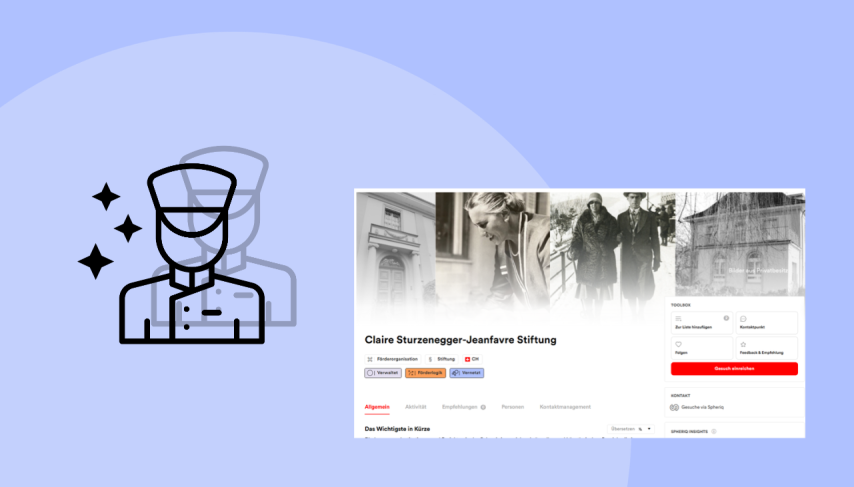
More and more funding organizations are relying on artificial intelligence to conduct preliminary reviews of grant applications. Spheriq Concierge reviews documents, checks against funding criteria, and researches background information. It does not make decisions, but it plays a crucial role in the triage process. Take the Claire Sturzenegger-Jeanfavre Foundation, for example. Executive Director Jeanette Cerquone offers insight into how this has changed her day-to-day work.
At first glance, the application seemed like a good fit—a cultural project, the kind the foundation generally supports. But the KI-Concierge’s research brought something surprising to light: culture was only one of about five thematic areas of the project. The applicant, however, had emphasized this aspect so strongly that the project’s actual focus was no longer apparent in the documentation.
Managing the Flood of Applications
For Jeanette Cerquone, the foundation’s executive director, this discovery was enlightening.
In the past, I might have had a few questions when reading such an application. Today, the Concierge provides me with information that helps me understand more quickly where those questions come from.
Jeanette Cerquone, Executive Director of the Claire Sturzenegger-Jeanfavre Foundation
The foundation supports social, cultural, and artistic projects, primarily in northwestern Switzerland. Although its funding criteria are quite nuanced, the number of applications received has nevertheless risen significantly in recent years. Since the start of the new funding cycle, it has also been using the AI Concierge for preliminary reviews.
The flood of applications hasn’t gotten any smaller as a result. But it’s easier to manage again. Instead of having to work her way through all the documents first, Cerquone can get an overview more quickly. The AI guides her to the key points, highlights open questions, and provides additional information that could be relevant to her assessment.
Four Services for a Thorough Preliminary Review
The Concierge has been in use at Spheriq since the spring of 2026. Since then, its range of services has been gradually expanded. Today, it assists with the preliminary review of applications in four areas.
First, it checks the quality of the submitted documents: Is the required information complete? Are the budgets and financing plans plausible? Do the details in the various documents match? Can the intended impacts be clearly derived from the planned activities? The Concierge checks for completeness, plausibility, and consistency. For example, it can derive impact chains and a Theory of Change from the documents and specifically draw attention to inconsistencies.
This process also brings everyday errors to light. For example, amounts that do not add up to the stated total, funding gaps that are not explained, or information that has been entered inconsistently. On one occasion, a vacation budget was even attached instead of the project budget. This is a mistake that can easily be overlooked by both applicants and funding officials. If it is caught early, the application can be easily returned for revision.
Second, the Concierge assesses the fit with the foundation. To do so, he is familiar with the foundation’s specific funding criteria: thematic priorities, geographic restrictions, target groups, funding requirements, and other exclusion criteria. He systematically compares the information in the application against these criteria. This goes beyond a general assessment. The concierge justifies each recommendation and refers to the relevant sections in the application documents. This makes it easy to understand why a criterion is considered met or where clarification is needed.
Third, it provides additional context. The concierge can take into account previous applications and funding decisions, evaluate organizational profiles, and research and compile publicly available information. What other projects have the participants already successfully implemented? Who are some of the known past supporters? How does the organization present itself to the outside world, and how is it covered in the media? And above all: Does this information paint a picture that aligns with—or is completely different from—the one presented in the submitted application?
It is precisely this additional perspective that Cerquone finds valuable. The example of the supposed cultural project shows that this approach allows us to do more than just verify individual details. Sometimes the context changes our understanding of an entire project.
Fourth, the Concierge prepares its findings for further processing. It generates a concise recommendation with a rationale and a traffic-light rating of green, yellow, or red. In addition, it provides a report whose structure and scope the foundation itself can determine. Some prefer a brief summary of the key findings, while others prefer a more detailed report with structured sections and tables. Whether it’s concise continuous text, bullet points, or the weighting of individual evaluation dimensions—the AI report can be customized and adjusted at any time later if needed. This creates a working document that is precisely tailored to the needs of the respective funding organization.
A concierge who is familiar with the foundation
In order for the concierge to perform these tasks reliably, he must have a thorough understanding of the foundation’s grant-making practices. The collaboration therefore begins with a five-part workshop series that the executive office conducts together with the Spheriq team.
Step by step, the team is working out what the AI-supported triage process should look like: What criteria are crucial? How are exceptions handled? What information must be available to make a recommendation? And how should the results be presented?
The workshops are not merely training sessions. Between sessions, the Spheriq team implements the requirements and continues to refine the funding organization’s concierge service. Participants begin working with an initial prototype as early as the second workshop. In the third workshop, this prototype is tested using real applications, and by the fourth workshop, a provisional setup is ready.
This approach thus differs from that of a general AI assistant, to which one submits a grant application with a request to evaluate it. The Concierge operates on the basis of an explicitly defined funding logic and a review process coordinated with the foundation. When an application arrives in the inbox, the Concierge has already analyzed the documents and prepared and supplemented them in accordance with the foundation’s guidelines.
More time for what really matters
Despite all the support provided by AI, the actual decision on funding remains the responsibility of humans. The Concierge can compile information, highlight inconsistencies, and provide rationale for assessments. Whether a discrepancy is actually relevant, how an organization or project should be classified, and whether it deserves funding must still be determined by those in charge.
Even AI itself is not entirely error-free. The information it retrieves may be incomplete or, on occasion, confuse someone with the same name as the requester. Its results must therefore be read with a critical eye.
“AI doesn’t work miracles. At the end of the day, you still have to work carefully. But a lot of things are easier to do. I get a better overview more quickly and can focus better on the content,” says Cerquone.
This change is not only reflected in more efficient application processing. The time saved can also be used in other ways: to visit an additional project receiving support, to take a closer look at an unusual proposal, or to follow up on an inquiry that might otherwise have resulted in an immediate rejection.
And Cerquone sees this as a source of further hope: that suspensions of new applications—which are necessitated solely by the large number of incoming applications and the associated processing workload—could become a thing of the past. In this sense, the Concierge also provides a clear advantage for applicants.
AI does not replace either the conversation or the judgment of funding officials. But it can significantly improve the conditions for these processes. It helps to understand applications more thoroughly and comprehensively, without every additional review requiring additional work time.
Because one thing is certain: The flood of applications isn’t going to get any smaller for the time being—if anything, it will get bigger. But it will become manageable again. And if this gives those in charge at funding organizations more time to focus on the projects and the people behind them, that’s a clear win.