
Following the disaster in Nepal, aid organizations sent out their first appeals for donations that very same day. These funds are essential for emergency relief. But more is needed. Existing local networks are necessary just to assess the situation.
Two months ago, on August 26, a devastating flood struck Nepal. The media reported on the events almost in real time. The images and videos showed the destructive impact of the flash flood. That very same day, aid organizations sent out their first appeals for donations. Although the organizations can use their existing resources, donations are crucial to their work. They rely on them to be able to respond appropriately to a disaster of this magnitude. Jürg Keim, Media Relations Manager at UNICEF, explains the importance of donations for emergency aid. “They make it possible to provide rapid assistance where the need is greatest—for example, with clean water, health care, protection for children, and support for families.” Donations from Switzerland and Liechtenstein would be particularly helpful in a rapidly changing situation and would allow for a flexible response.
Expand assistance
Helvetas echoes this sentiment . Katrin Hafner, the organization’s media relations officer, says, “Without donations, rapid emergency aid on this scale would not be possible.” The aid organization finances initial relief efforts from its emergency aid fund. “Donations also make it possible to quickly scale up aid and reach more affected people, which is urgently needed after a disaster of such immense scale and human suffering,” she says. Furthermore, she notes, donations are often a prerequisite for receiving additional funding from institutional donors.
The Swiss Red Cross (SRK) can also quickly deploy its own resources in the event of a disaster. However, donations make it possible to expand the scope of aid, as Joëlle Etienne, media spokesperson for the SRK, explains. She adds: “At the same time, the funds used are returned to the emergency aid reserves. This ensures that we can respond quickly and effectively when the next disaster strikes.”
When do organizations launch fundraising campaigns?
To decide whether to launch a fundraising appeal, organizations assess the situation. The assessments of staff and the local network play a key role. Based on this information, organizations can quickly analyze a disaster and determine what kind of support is needed. Within a few hours, the SRC decides whether to launch a fundraising appeal, as Joëlle Etienne explains. When assessing the situation, the first question to answer is: “Can we, as the Red Cross, provide effective assistance?” This depends on the type of assistance needed. Another key factor is whether there is a local presence.
Decisions are made quickly at UNICEF, too. Following the flood disaster in Nepal, the organization sent out a newsletter on the situation in the disaster area as early as August 26. “Our goal is to provide information quickly but responsibly—with a clear purpose and a realistic portrayal of what aid can achieve,” says Jürg Keim. The aim is not to engage in “alarmist communication,” but rather to provide transparent information about what the funds are being raised for.
Networks are essential
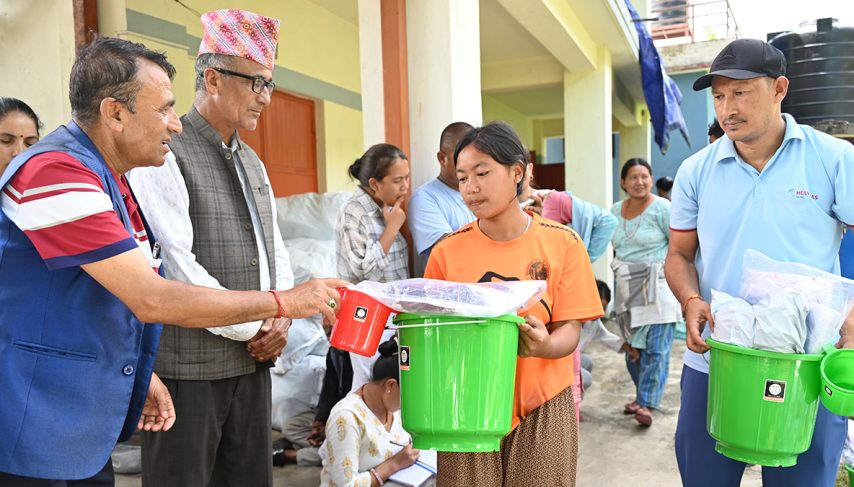
At the same time, on-the-ground aid efforts are getting underway. Helvetas and its partner organizations have been on the ground since day one. “The first priority was to identify the most urgent needs of the affected people and to coordinate relief efforts with local authorities and other organizations,” says Katrin Hafner. The various organizations demonstrate how relief efforts—especially in the early days—depend on existing networks and partner organizations. Emergency aid does not begin with the disaster. It relies on preparatory work to function effectively. This work is essential for carrying out the response and assessing the situation. Only in this way is rapid emergency aid possible.
UNICEF also began providing initial relief on the first day after the disaster. Jürg Keim says: “In the first few hours and days, the focus is on assessing the situation, prioritizing the most urgent needs, and then scaling up aid in a targeted manner.” How quickly aid becomes visible on the ground depends on the security situation, logistics, and accessibility. Support in the areas of water, sanitation, and hygiene—as well as health and nutrition assistance—was mobilized immediately. Thanks to relief supplies that had already been pre-positioned on site, the first shipments were dispatched within 24 hours and distributed in the affected areas within 48 hours.
Local Volunteers
“This example shows how important it is to invest in disaster preparedness and response capabilities. Pre-positioned relief supplies, established partner networks, and prepared procedures enable UNICEF to act quickly after a disaster—even when transportation routes are damaged or local supply systems are disrupted,” says Keim. The Swiss Red Cross (SRK) was also on the ground in Nepal with its partners. It works in collaboration with the Nepal Red Cross. Immediately after the flash flood, technical and financial assistance was made available to the Nepal Red Cross. But that’s not all.
Joëlle Etienne adds that it’s not just about money. “The Red Cross’s true strength lies in its volunteers,” she says. They are part of the communities. As a result, they can quickly get to the scene and help with the search. Volunteers and staff of the Nepal Red Cross support families in the search for missing relatives. “They provide water, food, and other essential supplies to people who have been displaced by the disaster. They work under extremely difficult conditions, and many of them have been directly affected by the disaster themselves.” The need for assistance does not end with emergency relief or media attention. Donations don’t just fund emergency aid; they help ensure flexible funding. Jürg Keim says that this allows UNICEF to tailor its assistance to actual needs, even beyond the acute phase.
Wide-Ranging Commitment
In Nepal, numerous organizations are still active in a wide variety of projects. Spheriq also features a selection of these organizations on Spendenschweiz.